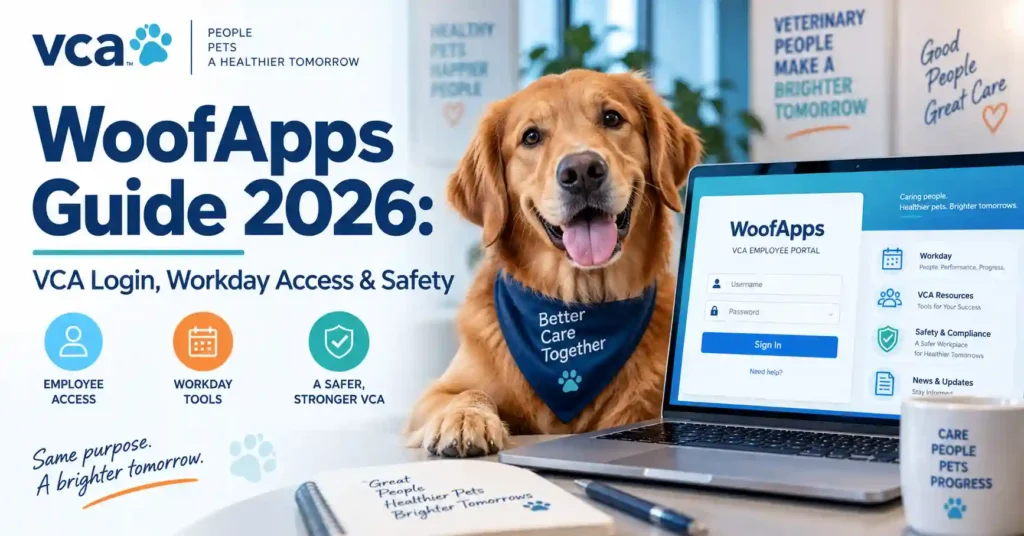
WoofApps: Complete VCA Employee Access, Login Safety, Workday, and Troubleshooting Guide
I have found that searching for woofapps creates more confusion than a workplace login should. Some pages describe WoofApps as a VCA Animal Hospitals employee portal, others present it as a pet-care application, and still others make detailed claims about payroll, scheduling, benefits, GPS tracking, or mobile features without clearly showing that VCA itself published those claims. For anyone simply trying to reach a work account, this mixture of information can make a straightforward task unnecessarily risky. In my analysis, the most useful way to understand WoofApps is to separate what VCA officially confirms from what independent websites say, then use safe access practices whenever credentials are involved.
That distinction matters because official VCA career pages clearly show that current associates use internal workplace systems such as Workday. VCA also publicly identifies WOOF University® as part of its professional-development offering. At the same time, VCA’s public-facing legal information identifies myVCA as a consumer-oriented VCA application. Those confirmed facts give us a reliable foundation. They also show why someone searching for “woofapps login” should not assume that every page containing the VCA name is an authorized login page.
Key Takeaways About WoofApps
The first thing I would keep in mind is that WoofApps is most commonly associated in current search results with workplace access for VCA associates, but the public web contains inconsistent descriptions of exactly what the term covers. Several independent sites call it a VCA employee portal or central gateway, while other sites describe WoofApps as a consumer pet-care platform. That disagreement is itself useful information because it tells us not to treat an unfamiliar search result as authoritative merely because its title contains “VCA” or “WoofApps.”
For practical purposes, readers should remember five points:
- VCA’s official career materials confirm that current associates use Workday for internal employment functions.
- VCA officially promotes WOOF University® as an education and development resource for associates.
- VCA separately identifies myVCA as one of its consumer-facing applications.
- Search results for WoofApps include independent websites whose descriptions and claimed features do not always agree with one another.
- Before entering an employee username, password, authentication code, payroll information, or other sensitive data, the safest route is to use a link supplied directly by VCA, your employer, HR, IT support, or another verified internal source.
From my perspective, that final point is the most important. Convenience should never outrank credential security.
What Is WoofApps?
The name WoofApps appears online primarily in connection with digital resources used by VCA Animal Hospitals employees. Independent pages commonly describe it as a central workplace portal or gateway through which associates can reach employment systems. However, I would avoid presenting every feature claimed by those pages as officially verified because VCA’s publicly accessible corporate and career materials do not provide a detailed public product page defining WoofApps feature by feature.
What VCA does confirm publicly is more concrete. Current VCA associates are repeatedly instructed in official job listings to access an internal career site through Workday. For example, current employees applying for another VCA position are directed to log into Workday and use the Jobs Hub or corresponding career functions.
VCA also confirms that its associate-development ecosystem includes WOOF University®. Its official benefits page lists WOOF University among educational opportunities and notes the availability of continuing education resources.
That evidence supports a careful definition: WoofApps can be understood as a name associated with VCA’s employee digital environment, but specific functions, URLs, authentication processes, and integrations should be verified through official VCA channels rather than assumed from third-party websites.
Why the WoofApps Name Creates Confusion
The term sounds like a consumer pet application, which is probably one reason search results have become muddled. A person unfamiliar with VCA might reasonably assume that “WoofApps” means apps for dogs or pet owners.
Some independent articles make exactly that interpretation. One describes WoofApps as a broad pet-management platform, while another says the name refers to both pet-owner tools and an employee system. Other search results define it strictly as a VCA internal employee portal.
The conflicting descriptions are a warning sign for researchers. They do not automatically mean that a particular website is malicious. They do mean we should distinguish between claims supported by VCA and claims repeated among independent publishers.
WoofApps Is Not the Same Thing as myVCA
One distinction can be made more confidently. VCA’s own terms explicitly identify the myVCA™ App as one of VCA’s online and mobile services. VCA also states that users may be able to access pet health records, including vaccination records, through its sites and applications.
That makes myVCA clearly consumer-facing in a way that public VCA materials do not establish for WoofApps.
If you are a pet owner looking for your animal’s information, appointments, health records, or VCA consumer services, searching for myVCA or starting from VCA’s official website is therefore more appropriate than entering credentials into a page labeled “WoofApps” simply because it appears in search results.
What VCA Officially Confirms About Its Employee Digital Ecosystem
I think this is where a useful WoofApps guide should become very precise. Instead of building a giant feature list from repeated blog claims, we can look at the workplace tools VCA itself publicly references.
Official VCA career listings say that existing associates should use the company’s internal career site through Workday when applying for other roles. The instructions appear across numerous current job pages, which gives us strong evidence that Workday is part of VCA’s real employee infrastructure.
VCA’s careers website also describes benefits, education programs, wellness resources, development opportunities, insurance offerings, retirement benefits, pet-care discounts, and WOOF University.
This does not prove that every one of these services sits inside a single WoofApps dashboard. It does show the kinds of employee resources that actually exist within VCA’s employment environment.
One statement from VCA’s careers site captures the company’s employee-support positioning:
“Taking care of the future of veterinary medicine starts with taking care of you.”
VCA Careers
I find this quote relevant because it gives context to the purpose of internal workplace systems. An employee portal should ultimately make essential administrative, educational, career, and benefits information easier for associates to reach. The quote does not prove any individual WoofApps feature, but it does reflect VCA’s published approach to supporting employees.
WoofApps, Workday, WOOF University, and myVCA Compared
The following comparison separates information supported by official VCA materials from broader assumptions that frequently appear in search results.
| Name | Main Audience | What Can Be Reliably Confirmed | Best Access Approach |
|---|---|---|---|
| WoofApps | Commonly associated with VCA employees | Search results widely describe it as an employee access environment, but detailed public VCA documentation is limited | Use an employer-provided or internally verified link |
| Workday | VCA associates and job applicants | VCA officially directs current associates to Workday for internal career access | Start with official VCA career or employer instructions |
| WOOF University® | VCA associates | VCA lists it as a professional-development and continuing-education resource | Access through VCA-provided employee resources |
| myVCA™ | VCA clients and pet owners | VCA officially identifies myVCA as its app and states that certain pet health information may be available through its sites | Start from VCA’s official consumer website or verified app listing |
The important takeaway is that similar branding does not mean identical purpose. A VCA employee looking for internal career information has a different destination from a pet owner looking for health records. VCA’s own documentation makes Workday, WOOF University, and myVCA easier to verify than many detailed claims currently circulating about WoofApps.
How to Access WoofApps and VCA Employee Resources Safely
A search engine is useful for research, but I would not make it my first choice for reaching an employee login page. This is especially true when the account may contain payroll, HR, benefits, tax, email, or employment information.
The Federal Trade Commission warns that scammers can place misleading results in search engines and use familiar company names to make a page appear legitimate. The FTC specifically advises users not to assume that the first result or displayed contact information is genuine.
That guidance is particularly relevant when searching for phrases such as “woofapps login,” “VCA employee login,” or “VCA Workday.”
Step 1: Start With a Source You Already Trust
Use a URL, bookmark, onboarding message, internal documentation, HR instruction, or IT resource that you received directly from VCA or your employer.
If you are a current associate and already have an approved employee homepage or intranet bookmark, start there rather than searching again each time.
For career-related activity, VCA’s public career pages confirm that current associates use Workday for internal job access.
Step 2: Check the Domain Before Entering Credentials
Read the domain carefully.
Attackers often rely on names that look close enough to the organization people expect to see. A site can contain “VCA,” “employee,” “benefits,” “Workday,” or “WoofApps” in the page title without proving ownership.
Look for spelling changes, extra words, unusual domain endings, unexpected redirects, or a login page reached through an unfamiliar chain of websites.
The FTC advises users who receive suspicious links to contact a company through a website or phone number they already know is genuine.
Step 3: Treat Unexpected Credential Requests Carefully
A legitimate employee service obviously needs authentication in many situations. The concern is not the existence of a login box. The concern is where that login box came from.
If a page appeared after clicking an unexpected email, text, advertisement, sponsored result, QR code, or unfamiliar website, verify the destination independently before entering anything.
This matters even when the screen looks polished. Modern phishing pages can closely imitate genuine Microsoft, HR, benefits, or single sign-on interfaces.
Step 4: Use Multi-Factor Authentication When Available
Multi-factor authentication adds another layer beyond the password. The FTC recommends two-factor or multi-factor authentication because it can make unauthorized access more difficult when a password becomes compromised.
It is still important to remain alert. Okta reported in 2026 that some phishing campaigns targeting employee-benefit and HR themes used sophisticated techniques capable of capturing credentials, authentication codes, and session information.
The practical lesson is simple: MFA is valuable, but it does not turn an unverified login page into a trustworthy one.
Step 5: Contact VCA Support Through a Verified Channel if Unsure
When access stops working, guessing at alternative login websites can create a larger problem than the original password issue.
Contact your manager, HR representative, internal IT desk, or another support route supplied directly by the organization. If you are using a public VCA resource, start from a VCA-controlled site rather than a third-party page claiming to provide support.
Why Login Safety Matters for WoofApps Searches
People often search for an employee portal because something has gone wrong. Perhaps a saved bookmark disappeared, a password expired, a new phone broke an authentication setup, or a new employee never saved the original onboarding link.
That urgency creates an ideal situation for misleading pages.
The FTC explains that scammers frequently create stories intended to pressure users into clicking a link or providing sensitive information. Those messages may claim there is suspicious activity, an account problem, or a need to confirm information.
The agency offers a useful principle:
“contact the company using a phone number or website you know is real”
Federal Trade Commission
In my view, this should be the default rule for WoofApps access as well. If the destination will receive an employee password or verification code, authenticity matters more than convenience.
Common WoofApps Access Problems and Practical Responses
Not every failed login means a security incident. Ordinary authentication problems are common across workplace systems.
The challenge is solving them without exposing credentials to an unverified service.
An Employee Password No Longer Works
An expired, changed, mistyped, or locked password can produce repeated login failures.
First confirm that you are on the approved company sign-in route. Then use the organization’s official password-reset process or contact internal support.
Avoid entering the same password into several websites that appear in search results. If the first page is not genuine, each additional attempt gives away more information.
Multi-Factor Authentication Is Failing
This can happen after changing phones, reinstalling an authentication app, losing device access, or experiencing a synchronization issue.
Use the recovery procedure supplied by the employer or contact internal IT.
Do not approve unexpected authentication prompts just to make them disappear. A verification request you did not initiate can indicate that somebody else is attempting to sign in.
Workday Access Is the Real Goal
Some users searching for WoofApps may actually be trying to reach Workday.
For current VCA associates seeking internal job opportunities, this is one area where the official instructions are clear: VCA career listings direct associates to log into Workday and use the Jobs Hub or relevant job-search function.
Instead of searching broadly for “woofapps Workday login,” an employee should follow the internally approved Workday route supplied by VCA.
Training Is the Real Goal
If you are looking for training or continuing education, WOOF University may be the term you actually need.
VCA’s official benefits page identifies WOOF University® as an educational resource and references continuing education opportunities.
A current VCA job listing also refers to free continuing education through online WoofU, adding further official evidence that the learning platform is part of VCA’s employee ecosystem.
A Pet Owner Has Landed on an Employee-Oriented Page
This is another likely source of confusion.
Pet owners should look for VCA’s consumer channels, including myVCA, rather than entering details into an employee portal.
VCA’s own legal documentation explicitly identifies the myVCA app and notes that certain pet health information may be accessible through its sites.
WoofApps Login Problems and the Safest Response
This table provides a simple decision framework for common situations.
| Situation | Likely Explanation | Recommended Action | What to Avoid |
|---|---|---|---|
| Password rejected | Wrong, expired, changed, or locked credentials | Use the verified company reset process or IT support | Trying credentials on multiple search-result sites |
| Authentication code fails | Device or MFA configuration problem | Use official recovery or contact support | Approving unexpected MFA prompts |
| Looking for internal VCA jobs | Workday may be the required destination | Follow VCA’s official Workday instructions | Using unofficial job-login mirrors |
| Looking for training | WOOF University may be the relevant resource | Use employer-provided learning access | Assuming every “Woof” branded site is connected |
| Pet owner looking for records | myVCA is likely more relevant | Begin with VCA’s official consumer channels | Using an employee-oriented login |
| Unfamiliar WoofApps page asks for credentials | Could be legitimate, unofficial, or misleading | Verify the URL with VCA before entering information | Trusting branding alone |
| Unexpected email sends you to a login page | Possible phishing attempt | Navigate independently through a known company route | Clicking first and verifying later |
The pattern is consistent: identify what you are actually trying to reach, then use the organization’s verified route rather than allowing a search result to choose the destination for you.
How Search Results Can Mislead People Looking for WoofApps
Search engines are designed to find relevant pages, not to guarantee that every result represents the organization named in the query.
That distinction becomes especially important with navigational searches. A person typing “woofapps login” usually does not want an article about the topic. They want a specific account page.
Yet current results include multiple independent domains discussing VCA employee access, WoofApps, login instructions, Workday, benefits, and related tools. Some describe WoofApps as a VCA employee portal, while others portray it as a pet-owner application or a broader pet technology concept.
Because these descriptions conflict, I would not use search ranking itself as evidence of authorization.
The FTC has specifically warned that scammers can use paid search placements, trusted names, and misleading descriptions to steer people toward the wrong site.
This does not mean every independent WoofApps website is fraudulent. It means authorization needs to be verified separately.
WoofApps and Employee Benefits Information
Benefits are another area where searchers should prefer primary sources.
VCA’s careers site publicly lists a range of benefits and employee resources, although eligibility can depend on the position, location, employment status, and other conditions.
The official benefits information includes health and well-being resources, professional development, education opportunities, retirement benefits, insurance-related benefits, pet-care discounts, and other programs.
VCA also publishes this employee testimonial on its careers site:
“VCA takes care of associates and finds ways to make our lives easier”
VCA Careers employee testimonial
I think that quotation is useful because employee portals matter most when they reduce friction around the practical parts of working life. However, benefit eligibility and current plan details should still be checked in official employment documentation rather than summarized from a third-party WoofApps article.
A Practical Example of Safe WoofApps Navigation
Consider a hypothetical scenario.
A VCA associate buys a new phone. The next morning, they search “woofapps login” because their old bookmark is gone. Several results appear. One uses the WoofApps name, another includes VCA in the page title, and another promises direct access to payroll and benefits.
The fastest option would be to click the first result and sign in.
The safer option is different.
The employee can open a previously verified VCA resource, use a company-issued device or bookmark if available, check onboarding documentation, or contact the internal support channel. If Workday is the destination, the employee can follow the Workday path supplied by VCA rather than a third-party intermediary.
This approach may require one extra step, but that step prevents a search engine result from becoming the authority on where sensitive credentials should go.
That is the practical principle I would apply to WoofApps every time.
Common Misconceptions About WoofApps
Several misconceptions appear repeatedly when people encounter the keyword.
Every Website Using the WoofApps Name Is an Official VCA Website
There is no safe basis for that assumption.
A website can discuss a brand without being operated by that brand. Domain names, page titles, logos, and familiar terminology should be treated as clues rather than proof of ownership.
WoofApps and myVCA Are the Same Product
The available evidence does not support treating them as the same thing.
VCA officially identifies myVCA as a consumer application. WoofApps search results, by contrast, are predominantly associated with employee access.
Every Feature Listed in a WoofApps Article Has Been Confirmed by VCA
This is also unsafe to assume.
Independent sites make detailed claims involving payroll, scheduling, communication, HR, benefits, Dayforce, Outlook, training, mobile access, and other functions. Some claims may accurately reflect employee experiences, but I have not found equivalent public VCA documentation confirming the complete feature lists commonly reproduced by these sites.
The responsible approach is to distinguish verified facts from third-party descriptions.
A High Search Ranking Proves a Login Page Is Legitimate
It does not.
The FTC explicitly warns consumers that misleading or scam-related search results can appear online and that even prominent results should be verified independently.
Multi-Factor Authentication Makes Any Login Page Safe
MFA improves security, but employees still need to verify the site before authenticating.
Recent Okta threat research documented sophisticated employee-benefits phishing campaigns capable of intercepting authentication flows and capturing credentials, MFA codes, and session tokens.
Expert Recommendations for Using WoofApps-Related Resources
Based on the available evidence, I recommend keeping the process simple.
First, save verified employee URLs once you receive them from VCA. A known bookmark is usually safer than repeating a navigational search every time you need payroll, training, HR, or career information.
Second, use official VCA pages as the starting point whenever a public route exists. VCA’s career site is particularly useful for confirming employment information, benefits, available positions, and Workday instructions.
Third, separate consumer and employee needs. Pet owners should use VCA’s consumer services rather than trying to interpret employee-oriented WoofApps search results.
Fourth, pause before entering credentials when a page is unfamiliar. Verify the domain and access route independently.
Fifth, treat authentication codes like passwords. Do not send them to another person or enter them into a page you have not verified.
Finally, ask internal support when uncertain. An employer can confirm the correct route more reliably than an independent article, forum, directory, or search snippet.
What to Do if You Entered Your Password on a Suspicious WoofApps Page
If you believe you entered workplace credentials into a fake or unverified page, I would treat the matter seriously rather than waiting to see whether anything happens.
Change the affected password through the legitimate account system as soon as possible. If the same password was reused elsewhere, change it on those accounts too.
Notify the relevant company IT or security team so they can advise you about account sessions, authentication resets, monitoring, or other internal procedures.
Review recent account activity if the service provides that capability.
If multi-factor authentication is available, ensure it is configured correctly, but also report any unexpected authentication requests.
The FTC recommends changing compromised passwords and turning on two-factor authentication when account information has been given to a scammer. It also advises users to take recovery steps promptly if account information has been exposed.
Do not continue communicating through the suspicious page simply because you already entered information once.
How I Would Evaluate a WoofApps Website Before Trusting It
When evaluating a page, I would use a simple evidence hierarchy.
An internally supplied VCA link, official employer communication, or confirmed corporate resource deserves the highest level of trust.
A VCA-controlled public webpage can also provide reliable confirmation for publicly documented facts.
A major service provider’s verified documentation can be useful when the question relates directly to that provider.
Independent articles can help reveal common terminology and search intent, but they should not be the final authority for credentials, benefits rules, payroll instructions, security settings, or employment policy.
Anonymous pages, copied guides, and websites making extraordinary feature claims without primary sourcing belong at the bottom of the hierarchy.
This approach does not require technical expertise. It simply requires asking one question before acting: Who is making this claim, and are they in a position to know?
Why WoofApps Still Matters Even With Limited Public Documentation
A workplace portal can be extremely important without having an extensive public product page.
Internal systems are built for employees, not necessarily for public marketing. Employers may intentionally keep instructions, links, authentication details, and internal documentation within onboarding materials or authenticated environments.
That helps explain why a person can encounter many independent WoofApps guides while finding relatively little public VCA documentation using the exact term.
What matters is not filling that gap with guesses.
We can confirm that VCA operates a substantial employee ecosystem involving Workday, continuing education through WOOF University, benefits programs, career development, and internal resources.
We can also confirm that myVCA is a separate VCA consumer application.
Beyond those points, internal employees should rely on the current information VCA provides directly.
Conclusion
I believe the most useful way to approach woofapps is not to memorize a long list of supposed features or trust whichever login page ranks first. The safer approach is to understand the role of VCA’s verified workplace ecosystem and use employer-approved access routes whenever sensitive credentials are involved.
Official VCA sources clearly support the presence of Workday in the employee environment and WOOF University as a professional-development resource. They also identify myVCA separately as a consumer-facing VCA application. What public sources do not provide is enough evidence to treat every independent WoofApps site, feature list, or login instruction as officially authorized.
For employees, the practical next action is simple: use a saved internal link, onboarding documentation, VCA-provided access point, or verified HR or IT channel. If you are unsure about a URL, verify it before signing in. For pet owners, start with VCA’s official consumer services rather than employee-oriented search results.
A few extra seconds spent confirming a destination can protect far more than a password.
Read More: Cñims: Meaning, CNIMS Confusion, Uses & Safety
Frequently Asked Questions
What Is WoofApps?
WoofApps is a term most commonly associated in current search results with VCA Animal Hospitals’ employee digital environment. Independent websites frequently describe it as an employee portal or gateway, but detailed public documentation directly from VCA about the WoofApps name is limited. VCA does publicly confirm employee use of Workday and provides WOOF University as a professional-development resource. For that reason, I recommend relying on VCA-provided internal instructions for the exact WoofApps access method rather than assuming an independent website is official.
How Do I Find the Official WoofApps Login?
The safest way to find the woofapps login is through a link supplied directly by VCA, your employer, HR, onboarding materials, internal IT, or an already verified employee bookmark. I would avoid selecting a login page solely because it appears near the top of a search engine. The FTC warns that misleading search results can imitate trusted organizations. If you cannot confirm the correct URL, contact VCA through a channel you already know is legitimate before entering your employee username, password, or authentication code.
Is WoofApps the Same as Workday?
No evidence I reviewed establishes WoofApps and Workday as the same product. Workday is a distinct platform that VCA officially tells current associates to use for internal career functions. Independent WoofApps guides often describe WoofApps as a broader gateway that may connect employees with multiple workplace resources, but that broader integration is not documented in detail on VCA’s public career pages. Employees looking specifically for internal VCA jobs should follow the official Workday instructions published by VCA.
Is WoofApps the Same as myVCA?
No. VCA’s official documentation identifies the myVCA™ App as one of its consumer-oriented applications, and VCA states that users may access certain pet health information through its sites. WoofApps, by contrast, is predominantly associated in search results with employee access. If you are a pet owner trying to view your pet’s information or use VCA’s client services, start from VCA’s official consumer website or verified myVCA application rather than an employee-focused WoofApps page.
Can I Use WoofApps to Access My VCA Benefits?
Independent websites frequently claim that WoofApps provides access to employee benefits, but I would verify the current route through VCA rather than relying on those third-party claims. VCA officially publishes information about health coverage, professional development, retirement programs, insurance, pet-care benefits, and other associate resources on its careers website. Actual eligibility and enrollment details can vary, so employees should use current internal benefit documentation or speak with HR for account-specific information.
What Is WOOF University?
WOOF University® is a VCA professional-development and education resource. VCA’s official benefits page lists WOOF University among its educational offerings and refers to continuing-education opportunities. Current VCA job listings also mention free continuing education through online WoofU. Employees looking for learning or development resources may therefore need WOOF University rather than a general web search for WoofApps. The exact employee access route should come from VCA’s internal resources or employer-provided documentation.
What Should I Do if My WoofApps Password Does Not Work?
First verify that you are using the legitimate employee sign-in route. If the destination is correct, use the company’s approved password-recovery procedure or contact internal support. Do not test the same credentials across multiple websites found through search results. If you suspect you already entered a password on an unverified site, change the password through the genuine service promptly, change it anywhere else you reused it, and notify the appropriate VCA support or security team.
Is WoofApps Safe?
The safety of a workplace service depends partly on whether you are actually using the authorized service. The keyword itself does not prove that a particular website is trustworthy. Search results contain multiple independent domains using the WoofApps and VCA terminology, so employees should verify the destination before entering credentials. Use employer-provided links, protect accounts with multi-factor authentication when available, and contact VCA directly when uncertain. The FTC similarly recommends using company contact information or a website you already know is genuine when a link seems suspicious.
Sources and References
- VCA Careers, official job listings: Current VCA associates are instructed to use Workday and the internal career site for employee job searches.
- VCA Careers, Benefits: Official information about employee benefits, WOOF University®, development programs, wellness resources, insurance, retirement benefits, and pet-care benefits.
- VCA Careers FAQ: Official information about VCA employment, benefits, application systems, and company practices.
- VCA myVCA Terms of Use: Official documentation identifying the myVCA™ App and describing account and pet-health-record provisions.
- Federal Trade Commission, How to Recognize and Avoid Phishing Scams: Guidance on suspicious messages, credential protection, multi-factor authentication, and verifying company contact information.
- Federal Trade Commission, Online Search Results: The Good, the Bad, and the Scammy: Guidance about deceptive paid search results and impersonation risks.
- Federal Trade Commission, What To Do if You Were Scammed: Account recovery recommendations after credentials may have been compromised.
- Okta Threat Intelligence: Research documenting employee-benefit and HR-themed credential phishing campaigns observed in 2025 and 2026.
- Independent WoofApps search results: Used only to evaluate how the term is being described online and to identify inconsistencies in public search intent, not as authoritative evidence of VCA’s internal systems.
Disclaimer
This article is an independent informational guide based on publicly available sources reviewed in September 2026. It is not an official VCA Animal Hospitals, Mars, Workday, Okta, or myVCA publication, and it is not affiliated with or endorsed by those organizations. Internal systems, login routes, benefits, authentication procedures, and employee resources can change without public notice. Employees should rely on current instructions provided directly by VCA, their manager, HR department, or authorized IT support before entering workplace credentials or making employment-related decisions. Third-party websites mentioned in search results are discussed only to explain the current information landscape and should not be interpreted as officially authorized login destinations.