
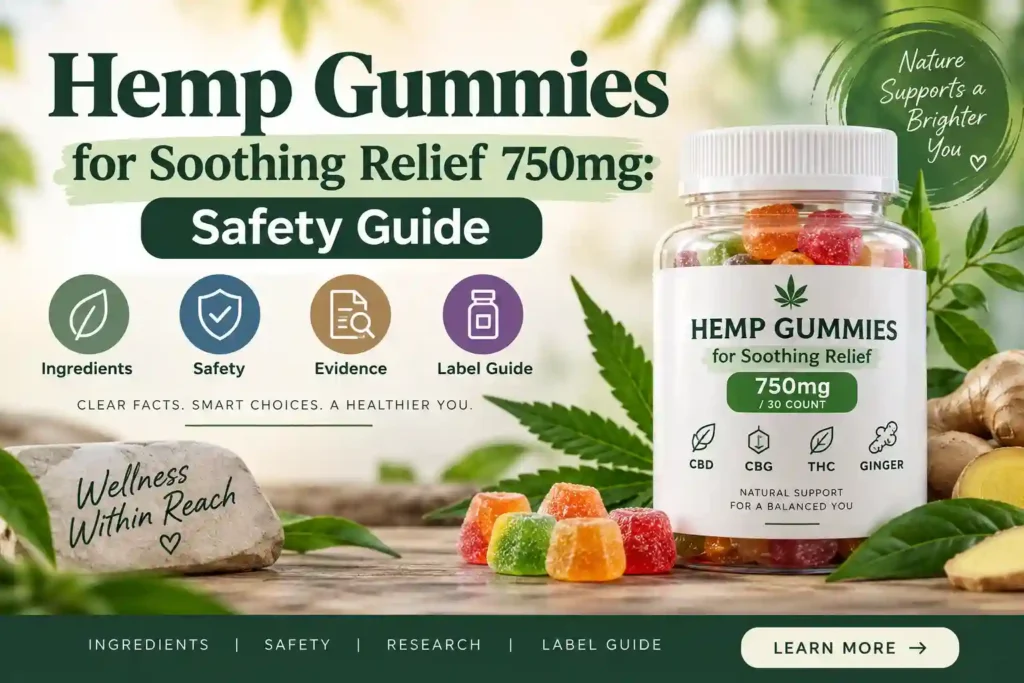
Hemp Gummies for Soothing Relief 750mg / 30 Count: Ingredients, Safety, Evidence, and Label Guide
I approach Hemp Gummies for Soothing Relief 750mg / 30 Count as a label, evidence, and safety question rather than simply accepting the word “relief” as proof of a medical effect. The product corresponds to a full-spectrum CBD gummy formula containing CBD, CBG, THC, and ginger, while the 750mg figure refers to the package’s total CBD content rather than 750mg in every gummy.
What matters most to me is separating three very different things: what the package contains, what the manufacturer says the product is designed to support, and what clinical research has actually established. A wellness product can have a carefully designed ingredient combination without being clinically proven to treat arthritis, chronic pain, inflammation, or another medical condition.
There is also a regulatory issue worth considering. Hemp-derived cannabinoid rules continue to evolve in the United States, which means consumers should check current federal and state requirements rather than assuming a product’s legal status will remain unchanged indefinitely.
Key Takeaways About Hemp Gummies for Soothing Relief 750mg / 30 Count
- The 750mg figure represents CBD across the 30-gummy package.
- That works out to approximately 25mg CBD per gummy.
- The formula may also include CBG, THC, and ginger.
- Full-spectrum means the product should not automatically be treated as THC-free.
- Research on cannabinoids does not establish this exact finished product as a proven treatment for chronic pain or inflammation.
- CBD may interact with medications and can produce side effects.
- Pregnancy, breastfeeding, THC sensitivity, and drug testing deserve special consideration.
- A batch-specific certificate of analysis can provide more useful information than front-label claims alone.
What Hemp Gummies for Soothing Relief 750mg / 30 Count Actually Are
The product is a full-spectrum hemp-derived gummy formula designed around CBD with additional cannabinoids and botanical ingredients. A 750mg, 30-count package contains 30 individual gummies, with the total CBD amount divided across those pieces.
For the 750mg format, the arithmetic is straightforward. Dividing 750 by 30 gives 25. This means each gummy provides approximately 25mg CBD when the package contains 30 gummies totaling 750mg.
The formula may also include CBG, THC, ginger, sweeteners, flavoring agents, pectin, and other gummy-making ingredients. I think this matters because a cannabinoid product should be evaluated as an entire edible product rather than only by the largest number printed on the front.
Understanding the 750mg and 30-Count Label
One of the easiest mistakes is to read “750mg” and assume one gummy contains 750mg. It does not. The number represents the total CBD content of the container.
The table below makes the package structure easier to understand.
| Label Component | Approximate Amount Per Gummy | Approximate Amount Per 30 Gummies | Why It Matters |
|---|---|---|---|
| CBD | 25mg | 750mg | This is what the headline 750mg figure refers to |
| CBG | Around 10mg | Around 300mg | A separate minor cannabinoid |
| THC | Small measurable amount | Varies by formulation | Relevant to sensitivity and drug testing |
| Ginger | Around 10mg | Around 300mg | Botanical ingredient used in the formula |
| Count | 1 gummy | 30 gummies | Determines how total CBD is divided |
My main takeaway from this table is that “750mg” provides only part of the information needed to understand the product. Comparing this package with another gummy requires looking at CBD per piece, THC per piece, minor cannabinoids, ingredients, serving guidance, and laboratory testing.
Why Batch-Specific Testing Matters
A product label gives the intended formulation, but laboratory testing can show what was actually measured in a particular production batch. A certificate of analysis can help confirm cannabinoid potency and may also include testing for heavy metals, pesticides, solvents, microorganisms, and other contaminants.
I would check the exact batch rather than assuming every production run is identical. Manufacturing variation can occur, and batch-specific reports are more useful than relying on an old test from a different lot.
What Full-Spectrum Means in This Formula
Full-spectrum generally means that a hemp extract contains multiple naturally occurring cannabis compounds rather than purified CBD alone.
In this product, that distinction matters because the formula includes more than CBD. It may contain CBG, THC, and other naturally occurring cannabinoids.
CBD itself is not considered intoxicating in the same way as THC. However, a full-spectrum product containing THC should not automatically be described as incapable of producing noticeable psychoactive effects.
That means a statement such as “hemp gummies cannot make you feel high” is too broad. The CBD component itself is non-intoxicating, but the finished formula may contain THC.
This distinction is particularly important for people who want to avoid THC because of workplace drug testing, athletic requirements, personal preference, legal restrictions, or previous sensitivity.
What the Main Ingredients Do
The formula combines several ingredients, but combining ingredients does not automatically create clinical evidence for the finished product. I find it more useful to examine the major components separately.
CBD
CBD stands for cannabidiol. It is one of the major cannabinoids found in cannabis and hemp.
CBD is generally described as non-intoxicating, meaning it does not produce the same type of high associated with THC. However, non-intoxicating does not mean completely risk-free.
CBD has been studied for several possible health applications. One purified prescription CBD medicine has received FDA approval for specific seizure disorders, but that does not mean ordinary retail CBD gummies are approved treatments for pain, inflammation, stress, or sleep problems.
CBG
CBG stands for cannabigerol. It is another cannabinoid naturally present in cannabis plants.
CBG has received increasing research interest, but human clinical evidence remains limited compared with more extensively studied compounds.
For that reason, I would treat the presence of CBG as a factual characteristic of the formula rather than proof that the product will reduce pain or inflammation.
THC
THC is the cannabinoid most closely associated with cannabis intoxication.
A full-spectrum hemp gummy may contain a small amount of THC while still being marketed as a hemp-derived product, depending on applicable law and formulation.
Even relatively small amounts of THC can matter to some people. Sensitivity can vary significantly, and repeated consumption may also matter for people subject to drug testing.
Ginger
Ginger is included as a botanical ingredient in many wellness products.
It has a long history of dietary use and has been researched for nausea, digestive concerns, inflammatory pathways, and musculoskeletal symptoms.
However, research quality varies depending on the condition and study design. I would describe ginger as a studied botanical ingredient rather than claiming that its presence proves the gummy will treat joint pain or inflammation.
Are Hemp Gummies for Soothing Relief 750mg / 30 Count Proven to Relieve Pain?
I would not describe Hemp Gummies for Soothing Relief 750mg / 30 Count as a clinically proven pain treatment unless strong clinical trials specifically testing the finished product become available.
This distinction matters because research involving purified CBD, prescription cannabinoid medicines, high-THC cannabis, balanced THC-CBD products, and retail hemp gummies should not be treated as interchangeable.
Some cannabinoid research has found possible benefits for certain types of chronic pain, while other studies have found little or no meaningful benefit from CBD alone.
The effects can vary according to cannabinoid ratios, doses, medical condition, route of administration, and study population.
The phrase “soothing relief” should therefore be understood as product positioning rather than proof of a medically established effect.
In my view, this approach gives consumers a more accurate understanding of what current evidence can actually support.
CBD Safety Issues That Matter
CBD is often described as natural, but natural does not automatically mean harmless.
CBD may cause side effects and can interact with medications. Reported concerns include drowsiness, digestive changes, appetite changes, liver-related effects, and interactions with other substances.
Medication interactions deserve particular attention because CBD can affect enzymes involved in drug metabolism.
People taking prescription medicines may therefore have a stronger reason to discuss CBD with a physician or pharmacist.
Sedation is another practical concern. Combining cannabinoids with alcohol, sedating medications, or other substances that reduce alertness can increase impairment.
I would avoid assuming that a gummy is automatically compatible with driving, operating machinery, or performing safety-sensitive work.
Pregnancy, Breastfeeding, and Children
Pregnancy and breastfeeding require additional caution.
Health authorities generally advise avoiding CBD and THC during pregnancy and breastfeeding because important questions remain about fetal and infant exposure.
People who are pregnant or nursing should not treat over-the-counter availability as evidence that a cannabinoid product is safe.
CBD and THC gummies should also be stored securely away from children.
Gummies can resemble ordinary candy, which creates a risk of accidental consumption.
Child-resistant storage and careful labeling are therefore important practical precautions.
Drug Testing and THC Exposure
Anyone subject to workplace or athletic drug testing should not assume that a product labeled “hemp” or “CBD” is THC-free.
Full-spectrum products may contain measurable THC.
Drug-testing outcomes can depend on several factors, including frequency of use, product potency, individual metabolism, testing thresholds, and test type.
I would not describe any full-spectrum THC-containing gummy as guaranteed to be safe for drug testing.
For people whose employment, sports participation, licensing, or legal situation depends on avoiding THC, this can be one of the most important considerations.
How to Evaluate Hemp Gummies for Soothing Relief Step by Step
When I evaluate a product like this, I prefer a repeatable process rather than simply asking whether the marketing sounds convincing.
Step 1: Confirm the Exact Product Strength
Check whether the package contains 750mg CBD, 1500mg CBD, or another amount.
For a 750mg package containing 30 gummies, the nominal CBD amount is approximately 25mg per gummy.
Step 2: Read the Full Cannabinoid Panel
Do not stop at the CBD number.
Check whether the formula also contains THC, CBG, CBN, CBC, or other cannabinoids.
This matters because two products with the same CBD amount can still have very different effects and risk profiles.
Step 3: Find the Certificate of Analysis
Look for a batch-specific laboratory report.
The report should ideally include cannabinoid potency and contaminant screening.
Useful areas to review include:
- CBD content
- THC content
- CBG and other cannabinoids
- Heavy metals
- Pesticides
- Residual solvents
- Microbial contamination
- Mycotoxins
Step 4: Compare the Laboratory Report With the Label
Check whether the measured cannabinoid amounts reasonably correspond with what the packaging claims.
Small variation can occur, but major differences deserve closer attention.
Step 5: Review Medications and Medical Conditions
People taking prescription medication should consider possible cannabinoid interactions.
People with liver problems or other significant medical conditions may also require additional caution.
Step 6: Consider Drug Testing
If a positive THC test could create professional or legal problems, check whether the product contains any measurable THC.
Step 7: Check Current Law
Cannabinoid laws can differ by jurisdiction and may change over time.
A product that can legally be sold in one location may be regulated differently elsewhere.
Common Mistakes When Reading Hemp Gummy Labels
One common mistake is assuming that a large number on the front represents the amount in one gummy.
With a 750mg, 30-count product, the CBD amount works out to approximately 25mg per gummy.
Another common mistake is assuming “hemp” means THC-free.
Full-spectrum hemp products may contain THC.
A third mistake is treating the word “relief” as proof of a medical effect.
Product names and marketing terms communicate intended positioning. They do not replace controlled clinical research.
Another misconception is assuming that every “lab-tested” product has undergone the same level of analysis.
The value of laboratory testing depends on which contaminants were tested, whether the report is current, whether the lot number matches the package, and whether the laboratory is independent.
Safety and Quality Checks at a Glance
The table below summarizes important points to review.
| Issue to Check | Why It Matters | Practical Response |
|---|---|---|
| CBD amount per gummy | Package totals can be misunderstood | Divide total CBD by gummy count |
| THC content | Relevant to impairment and drug testing | Review label and COA |
| Medication interactions | CBD may affect other medicines | Ask a physician or pharmacist |
| Liver concerns | CBD may affect liver function in some situations | Use additional caution if risk factors exist |
| Pregnancy or breastfeeding | Cannabinoids are generally discouraged | Seek medical guidance |
| Contaminants | Product quality can vary | Review third-party testing |
| Drug testing | Full-spectrum products can contain THC | Do not assume they are test-safe |
| Legal status | Regulations vary | Check current local law |
The most useful questions are concrete. What does one gummy contain? What did the laboratory measure? Does it contain THC? Are medications involved? What laws apply where the consumer lives?
Those questions are usually more informative than simply asking whether hemp gummies are “good” or “bad.”
Understanding the Regulatory Environment
Hemp-derived cannabinoid laws continue to evolve.
Federal and state rules may address THC concentration, product format, labeling, age restrictions, packaging, manufacturing standards, and retail availability.
Consumers should also understand that a product meeting one legal definition of hemp does not automatically mean every marketing or health claim complies with food, supplement, or drug regulations.
I believe this is especially important for cannabinoid products because legal terminology can create a false impression that federal hemp status equals general FDA approval.
Those are different regulatory questions.
Evidence-Based Recommendations for Reading This Product
My strongest recommendation is to judge Hemp Gummies for Soothing Relief 750mg / 30 Count by verifiable product information rather than by the promise implied by the product name.
The 750mg figure indicates total package CBD. With 30 gummies, that means approximately 25mg CBD per gummy.
The presence of additional cannabinoids also matters. A full-spectrum product can have a significantly different profile from CBD isolate or broad-spectrum products.
I also believe a current COA deserves more weight than an old review or retailer description.
Formulations can change, measured potency can vary, and regulations continue to develop.
Health claims deserve similar caution.
Research involving one cannabinoid formulation should not automatically be used to make claims about another.
A study of purified CBD does not prove that a CBD, CBG, THC, and ginger gummy works the same way.
Likewise, evidence involving pharmaceutical cannabinoid products should not automatically be transferred to ordinary wellness gummies.
Medication interactions, pregnancy, breastfeeding, THC sensitivity, and drug testing should be treated as important decision factors rather than minor details.
Conclusion
I see Hemp Gummies for Soothing Relief 750mg / 30 Count primarily as a full-spectrum cannabinoid product that requires careful label reading rather than as a clinically established pain medicine. The 750mg figure represents the total CBD content of the package, which means approximately 25mg CBD in each of 30 gummies.
The formula may also contain CBG, ginger, and a measurable amount of THC. Those ingredients matter because they influence how the product should be evaluated for safety, drug testing, interactions, and individual sensitivity.
The research picture is more restrained than product marketing may suggest. Existing cannabinoid studies do not automatically prove that this particular gummy provides a specific medical benefit.
For me, the practical lesson is simple. Read the per-gummy amounts, check the current certificate of analysis, identify whether THC is present, review possible medication interactions, and verify current legal requirements.
Those steps provide much more useful information than relying on the word “relief” alone.
Read More: YarrList: What It Is, How It Works, Features, App, and Safety
Frequently Asked Questions
What Does Hemp Gummies for Soothing Relief 750mg / 30 Count Mean?
Hemp Gummies for Soothing Relief 750mg / 30 Count refers to a package containing 30 gummies with approximately 750mg total CBD. Dividing 750mg by 30 gives approximately 25mg CBD per gummy. The 750mg number should not be interpreted as the amount contained in one gummy.
How Much CBD Is in Each 750mg Relief Gummy?
Each gummy contains approximately 25mg CBD when a package contains 750mg total CBD divided across 30 gummies. Consumers should still verify the package label and laboratory report because formulations can change.
Do Hemp Gummies for Soothing Relief 750mg / 30 Count Contain THC?
A full-spectrum formulation may contain measurable THC. Anyone who needs to avoid THC completely should review the label and certificate of analysis rather than assuming that a hemp-derived product is THC-free.
Will These Gummies Make Someone Feel High?
CBD itself is considered non-intoxicating, but a full-spectrum gummy containing THC may produce different effects depending on the amount consumed and individual sensitivity. It is therefore better to evaluate the full cannabinoid profile rather than focusing only on CBD.
Are These Gummies Proven to Treat Pain or Arthritis?
No strong product-specific clinical evidence establishes these gummies as a proven treatment for pain or arthritis. Research on cannabinoids remains mixed and often involves products, doses, and formulations that differ from ordinary retail hemp gummies.
What Is CBG in the Relief Gummies?
CBG stands for cannabigerol. It is a cannabinoid naturally found in cannabis plants. Researchers continue to study CBG, but current evidence is not strong enough to assume that its presence in a gummy guarantees a particular therapeutic effect.
Why Is Ginger Included?
Ginger is commonly used as a botanical ingredient in wellness products. It has been studied for several purposes, including nausea and musculoskeletal symptoms, but the quality of evidence varies depending on the condition.
Can CBD Gummies Interact With Medication?
Yes. CBD can interact with some medications by affecting drug metabolism. Anyone taking prescription medication should consider discussing CBD use with a physician or pharmacist.
Are These Gummies Safe During Pregnancy or Breastfeeding?
Cannabinoid products containing CBD or THC are generally discouraged during pregnancy and breastfeeding. People who are pregnant or nursing should seek appropriate medical guidance rather than relying on retail product marketing.
Can Full-Spectrum Hemp Gummies Cause a Positive Drug Test?
Yes, they may create a drug-testing risk if they contain THC. A positive result can depend on the amount consumed, frequency of use, individual metabolism, product potency, testing method, and threshold.
What Should I Look for in a CBD Certificate of Analysis?
Check that the report matches the exact product and batch. Review the measured CBD, THC, and other cannabinoid amounts. Also look for testing related to pesticides, heavy metals, residual solvents, microbes, and other contaminants.
Sources and References
- Alchemy Naturals product information for CBD gummies and full-spectrum formulations.
- U.S. Food and Drug Administration consumer guidance on CBD safety and interactions.
- Agency for Healthcare Research and Quality reviews of cannabis and cannabinoid treatments for chronic pain.
- Centers for Disease Control and Prevention information about CBD and cannabis.
- National Center for Complementary and Integrative Health information about cannabinoids and ginger.
- Relevant federal and state regulatory materials concerning hemp-derived cannabinoid products.
Disclaimer
This article is for general informational and educational purposes only. It is not medical, pharmaceutical, or legal advice and does not diagnose, treat, cure, or prevent any disease. CBD, THC, CBG, botanical ingredients, product formulations, laboratory results, and laws can change, and individual responses can vary. Anyone who is pregnant or breastfeeding, uses prescription medication, has a medical condition, is subject to drug testing, or has questions about cannabinoid use should seek guidance from an appropriate qualified healthcare professional.