YarrList: What It Is, How It Works, Features, App, Safety, and Legal Risks
I found that YarrList is best understood as an online directory rather than a conventional streaming service. Current YarrList-related websites and the project’s public GitHub repository describe a collection of categorized links covering movies, television, anime, live sports, torrents, games, apps, music, eBooks, comics, manga, and other online resources. The important distinction is that YarrList generally points users toward third-party websites instead of hosting all of that entertainment itself. The project’s public GitHub repository goes even further and openly describes YarrList as a project for exploring piracy-related resources.
That description immediately creates two separate questions. The first is practical: what does YarrList actually do? The second is more important: what are the security, copyright, and privacy implications of following links from a directory whose own repository openly associates itself with piracy? Those questions deserve to be separated because a clean directory interface does not guarantee that every destination listed inside it is safe, authorized, legal, or trustworthy.
There is also a Yarrlist Android application on Google Play, but it should not automatically be treated as identical to every YarrList website. The Google Play listing describes an app for discovering movies and television shows, watching trailers, browsing genres, building watchlists, and planning what to watch next. It lists DIATTA DEMBA as the developer and reports more than 10,000 downloads. The listing also says the app may collect and share device or other identifiers.
In my analysis, the safest way to understand the keyword is therefore to distinguish the YarrList web directory, the Yarrlist Android app, and various similarly named domains that may not all be operated in exactly the same way. This article explains each of those elements without directing readers toward unauthorized copyrighted material.
Key Takeaways About YarrList
Several facts help clarify what YarrList currently represents.
- YarrList is primarily presented as a directory that organizes links to third-party websites.
- Its public GitHub repository describes categories including movies, television, anime, sports, torrents, games, music, eBooks, comics, VPNs, and ad blockers.
- The GitHub project describes itself using the phrase “Explore World Of Piracy.”
- The project has moved between domains and maintains or has maintained several backup addresses according to its public GitHub documentation.
- YarrList generally functions as a directory rather than hosting every piece of media itself.
- A separate Yarrlist Android app is available on Google Play and focuses on movie and television discovery, trailers, genres, and watchlists.
- The Android app listing states that device or other identifiers may be collected and shared with third parties.
- Following links to unfamiliar free streaming or download websites can expose users to pop-ups, deceptive downloads, tracking, or malware.
- The US Federal Trade Commission specifically warns consumers against unfamiliar websites offering free movies, shows, games, and other downloads because malware can be hidden in such material.
- Copyright status depends on whether the particular site and content are authorized by the rights holder.
- A directory listing a website does not establish that the destination has permission to distribute copyrighted content.
- Users should distinguish legal free services from unauthorized streaming, torrent, or download sources.
- YarrList itself warns users about ad blocking and VPN use on some of its current directory pages, which suggests that outbound destinations may vary substantially in usability and risk.
What Is YarrList?
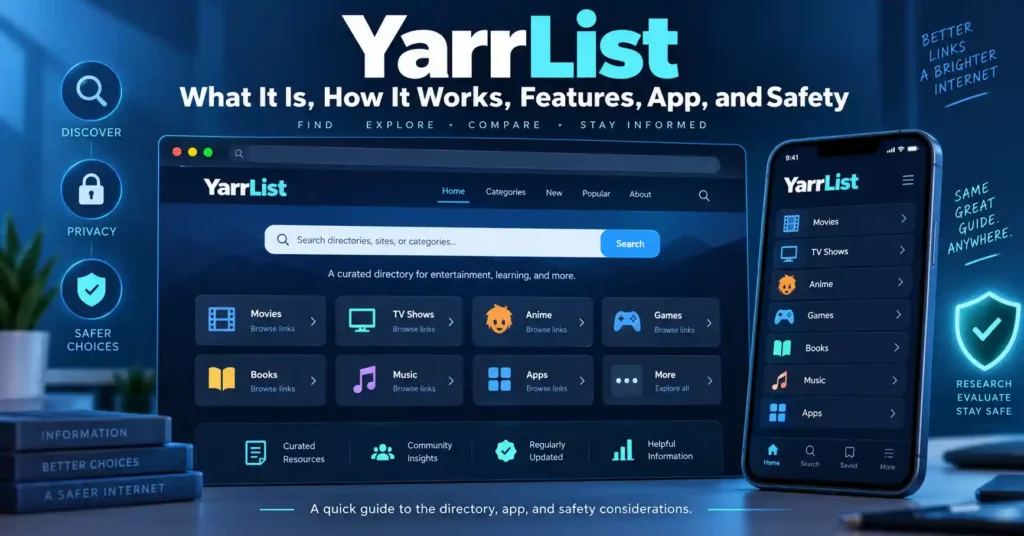
YarrList is an online link directory designed to organize entertainment and internet resources into categories. Instead of acting like a single streaming platform with its own licensed catalog, it generally directs visitors toward external websites.
One currently indexed YarrList page describes itself as a hand-curated directory of free streaming, download, and browsing websites. It says the directory covers movies, anime, manga, sports, music, games, eBooks, and other categories and claims that links are tested and updated.
Another YarrList-branded website similarly displays categories for movies and television shows, live sports, live television, anime, manga, torrents, games, app stores, music, eBooks, comics, Asian dramas, VPNs, ad blockers, news, and reference information.
The public GitHub repository provides perhaps the clearest evidence of the project’s underlying purpose because it explicitly categorizes free movie and television sources, torrent resources, games, music, eBooks, VPN tools, and other material. The repository is public and had hundreds of stars when indexed, showing that the project has attracted a substantial online audience.
The repository’s own description is unusually direct:
“Yarrlist: Explore World Of Piracy”
YarrList GitHub repository
That description matters because it removes much of the ambiguity created by generic descriptions such as “free entertainment directory.” It tells readers that at least the public GitHub project explicitly associates itself with piracy-oriented discovery.
However, that does not mean every individual link listed by every YarrList-branded page is necessarily infringing. Some free media websites operate legally through advertising, public-domain material, Creative Commons licensing, free-to-play models, creator permission, or official distribution arrangements. The legal status has to be evaluated at the destination and content level.
How YarrList Works
The basic YarrList concept is simple.
Instead of searching the wider web for entertainment websites, a visitor opens a categorized directory and selects a type of resource. The directory then provides links leading to external websites.
For example, someone interested in anime may choose an anime category. A person looking for gaming resources may open a gaming category. Another visitor may browse eBook, music, or sports categories.
The YarrList directory therefore behaves more like a curated bookmark collection than a traditional subscription platform.
This distinction matters because the user leaves YarrList when following many of those links. At that point, the destination site’s privacy practices, advertising system, security, copyright status, account requirements, cookies, downloads, and malware risks become relevant.
A directory can organize links but cannot automatically make every external destination safe.
Imagine a hypothetical directory listing ten movie websites. The directory interface itself may contain no malware at all. Nine destinations might behave normally, while the tenth might present a fake “Update Your Player” button that downloads unwanted software.
The risk comes from the external destination rather than the directory page.
This is why evaluating YarrList requires looking beyond whether YarrList itself loads cleanly.
What Categories Does YarrList Include?
Current YarrList sources describe a broad range of categories.
The project’s GitHub documentation includes movies and television, anime, live sports, live television, manga, torrents, comics, games, music, eBooks, VPNs, and ad blockers. Some related pages add apps, Asian dramas, news, reference sources, and adult material.
The table below summarizes the general role of those categories without directing readers toward particular unauthorized content sources.
| YarrList Category | Typical Purpose | Main Issue to Consider |
|---|---|---|
| Movies and TV | Finding third-party streaming resources | Copyright authorization and malicious ads |
| Anime | Discovering anime-related platforms | Licensing varies by website and region |
| Live Sports | Finding sports streams | Broadcast rights are highly jurisdiction-specific |
| Live TV | Locating television streams | Many channels require licensed distribution |
| Manga | Finding reading platforms | Publisher authorization matters |
| Torrents | Peer-to-peer file discovery | Downloaded files may be copyrighted or unsafe |
| Games | Game-related download or discovery sources | Malware and unauthorized copies can be concerns |
| Apps | Finding software sources | Sideloaded software may create security risk |
| Music | Streaming or downloading music | Distribution rights vary |
| eBooks | Finding digital books | Many books remain copyright protected |
| Comics | Digital comic resources | Publisher licensing should be checked |
| VPNs | Privacy and network tools | VPN quality and logging policies vary |
| Ad blockers | Reducing unwanted advertising | Browser compatibility and trustworthiness matter |
The important point is that YarrList covers far more than streaming movies. Its value proposition is centralized discovery across many categories, but broader coverage also means users face many different legal and technical risks.
YarrList Is a Directory, Not a Traditional Streaming Service
This distinction is one of the most important points for readers who arrive after searching phrases such as “YarrList movies.”
A traditional streaming service typically hosts or licenses access to content within its own platform. Users browse a catalog and play titles without being sent to unrelated websites for every movie.
YarrList works differently.
Its own descriptions emphasize curated links and third-party destinations. One indexed page specifically explains that YarrList is not itself a streaming platform but a directory connecting users with external websites.
This means there may be no consistent player, privacy policy, account system, content license, or security standard across everything a YarrList user encounters.
Each external website may be independently operated.
One may show advertisements.
Another may request registration.
Another may use multiple redirect pages.
Another may attempt to send browser notifications.
Another may contain downloads.
Another may disappear completely.
That variation is central to understanding the YarrList experience.
YarrList Domains and Why the Address Can Change
YarrList has used multiple domain names.
The project’s public GitHub documentation identifies yarrlist.net as a main domain and lists backup domains including yarrlist.xyz, yarrlist.icu, ahoylist.net, and other alternatives at different points.
This pattern is common among websites operating in copyright-sensitive or unstable areas of the web.
Domains may change because of hosting problems.
They may change because a registrar suspends a domain.
Search-engine visibility can change.
Operators sometimes move websites for branding reasons.
A site can also be cloned by unrelated parties.
That last possibility is especially important.
If users become accustomed to searching for the brand name rather than using a stable official source, copycat websites can take advantage of that behavior.
A fake YarrList page could imitate the design while replacing outbound links with malicious downloads, phishing pages, or aggressive advertisements.
For that reason, I would not assume that every domain containing “yarrlist” belongs to the same operator.
The project’s public GitHub repository is more useful than random search results for understanding which domains the project itself has historically identified as official or backup addresses.
What Is the Yarrlist Android App?
There is also an Android application named Yarrlist on Google Play.
The app listing says its purpose is to help users discover movies and television shows, browse popular titles, watch trailers, explore genres, create watchlists, and plan movie nights.
That description is substantially more conventional than the YarrList web directory.
The app does not describe itself on Google Play as a piracy directory.
User reviews visible in the listing also indicate that at least some people expected full movie playback but found that the application primarily showed trailers. One August 2026 reviewer wrote that they could only see trailers, while another June review made a similar observation.
The Google Play listing identifies DIATTA DEMBA as the developer and reports more than 10,000 installs.
It also contains useful privacy disclosures.
According to the developer-provided Data Safety section, the application may share device or other IDs with third parties and may collect the same type of data. Google Play reports that data is encrypted in transit and says the listing indicates that data cannot be deleted.
Those disclosures are more useful than assuming that an app with a familiar name inherits the policies of similarly named websites.
YarrList Website and Yarrlist App Compared
The directory and the Android app should be evaluated separately.
| Feature | YarrList Web Directory | Yarrlist Android App |
|---|---|---|
| Main purpose | Organizing links to external resources | Movie and TV discovery |
| Streaming role | Directs users to third-party websites | Google Play description emphasizes trailers |
| Categories | Movies, anime, games, torrents, music, books, sports, and more | Movies and TV |
| Watchlists | Not the core directory function | Advertised feature |
| Trailers | Depends on linked resources | Advertised directly |
| Third-party links | Central to the service | Less central in store description |
| Privacy information | Depends on specific domain | Google Play provides developer disclosures |
| Developer identity | Public project identity visible through GitHub | DIATTA DEMBA listed on Google Play |
| Piracy association | GitHub explicitly uses piracy terminology | Store listing does not describe itself this way |
| Security exposure | Mainly depends on outbound sites | Standard mobile-app permissions and data practices also matter |
I would therefore avoid saying “the YarrList app lets you stream everything listed on YarrList.” The available evidence does not establish that.
Is YarrList Free?
The web directory presents itself as a free resource.
Current indexed descriptions emphasize free links, no signup, and categorized access.
However, “free” can describe several different things.
The YarrList directory may be free to browse.
An external destination may be ad-supported.
Another external site may charge for premium features.
A torrent may require no payment but still contain copyrighted material.
A legal service may offer a free advertising-supported catalog.
Another website may use misleading payment prompts.
The fact that YarrList itself does not charge a subscription therefore tells us little about the business model or legitimacy of each external destination.
This is another reason to evaluate outbound websites individually.
Is YarrList Safe?
There is no single yes-or-no answer because YarrList primarily sends users to external websites.
A directory page can be technically safe while containing links to websites with poor security practices.
The reverse is also possible: some destinations may be perfectly legitimate even if the directory’s overall reputation is questionable.
Third-party security services also disagree about specific YarrList domains. One service classified yarrlist.net as potentially malicious and cited suspicious scan results, while another automated reputation provider gave the same domain a much more positive assessment.
That disagreement is a good reason not to treat automated website reputation scores as definitive.
The strongest general guidance comes from consumer-protection authorities.
The FTC advises users not to use unfamiliar websites to download free material such as music, movies, shows, or games because those sources can expose devices to malware.
The agency’s advice is direct:
“Don’t use unfamiliar websites to download free stuff”
Federal Trade Commission
That guidance is particularly relevant to directories like YarrList because users may be sent to websites they have never encountered before.
Malware Risks Around Free Streaming and Download Sites
Free entertainment websites can attract attackers because users arrive expecting to click play buttons, download files, close pop-ups, or install software.
That environment makes deceptive buttons effective.
A fake video player may display “Codec required.”
A download page might present several buttons, only one of which is genuine.
A website may ask visitors to enable browser notifications.
Another may claim that the device is infected and needs immediate repair.
Torrent downloads can contain executable files disguised as something else.
Game downloads can be modified to include malicious code.
Browser extensions offered by unfamiliar websites may request extensive permissions.
The FTC has warned specifically that illegal streaming apps and services have been used to distribute malware and that malicious software can expose login credentials, financial information, personal data, and other devices on the same network.
That means security risk is not merely theoretical.
How to Evaluate a YarrList Link Before Opening It
I would use a simple process before following any unfamiliar destination.
First, examine the domain name.
Does it look like an established service or an imitation?
Second, check whether the destination has HTTPS.
HTTPS does not prove legitimacy, but its absence is an additional warning sign.
Third, look for an identifiable operator, privacy policy, and terms.
Fourth, avoid downloading executable files simply because a streaming page tells you they are required.
Fifth, be cautious with sites requesting browser-notification permission.
Sixth, do not enter payment-card information simply to prove that you are “over 18” or to unlock a supposedly free stream.
Seventh, check whether the service clearly explains how it has the right to distribute the content.
Eighth, keep your operating system and browser updated.
These habits do not make unauthorized sites legal, but they reduce some of the avoidable security risks that arise when browsing unfamiliar destinations.
Is YarrList Legal?
The answer depends on what activity is being discussed and which country’s law applies.
A directory containing links is not automatically identical to directly hosting copyrighted material.
However, legal questions can arise when websites facilitate access to unauthorized copies, especially when their purpose, design, and knowledge of infringement become relevant.
Copyright law also varies internationally.
In the United States, the Copyright Office explains that copyrighted works receive protection upon creation and warns that downloading copyrighted material through peer-to-peer networks can create infringement liability. It recommends authorized services as a way to avoid those risks.
The Copyright Office states:
“there is a risk of liability for downloading material from these networks.”
U.S. Copyright Office
The important point is not that every YarrList link is illegal.
It is that “free” does not establish authorization.
A free service may have permission.
Another may be distributing copyrighted works without permission.
Users should examine the actual source.
Streaming and Copyright Are Not the Same in Every Country
Copyright rules vary by jurisdiction, and the legal consequences for viewers, uploaders, website operators, and link directories are not identical.
In the United States, copyright owners possess exclusive rights that include reproduction and public performance. The Copyright Office has explained that unauthorized retransmission of copyrighted streams can infringe public-performance rights and that server copies can also implicate reproduction rights.
Other countries apply their own statutes, court decisions, enforcement mechanisms, and private-blocking regimes.
That makes broad claims such as “watching any free stream is always legal” unreliable.
It also makes the opposite claim too broad.
Public-domain films exist.
Rights holders sometimes publish material for free.
Some creators authorize fan distribution.
Libraries provide digital access.
Advertising-supported legal services exist.
Therefore, the legal question is whether the content is being distributed with appropriate authorization under the applicable law.
Does Using a VPN Make YarrList Legal?
No.
A VPN can change how network traffic is routed and may reduce what certain intermediaries can see, depending on the provider and configuration.
It does not create copyright permission.
If an activity is unlawful in a particular jurisdiction, routing the connection through another server does not automatically make the underlying activity lawful.
YarrList pages often mention VPN use, but I would interpret that as a technical or privacy suggestion rather than legal authorization.
VPNs also introduce a new trust relationship.
The provider may potentially see information about connections.
Some retain logs.
Some monetize user data.
Some make misleading privacy promises.
A VPN therefore should be evaluated on its own technical and privacy merits rather than treated as a universal safety switch.
Does an Ad Blocker Make YarrList Safe?
An ad blocker can reduce exposure to some advertisements, pop-ups, scripts, and visual clutter, depending on the browser and extension.
That can improve usability on sites with aggressive advertising.
However, an ad blocker does not guarantee safety.
A malicious file can still be downloaded manually.
A phishing page can still request credentials.
A fake login page may not involve advertising at all.
A compromised website can contain harmful scripts in its own code.
A user can still install a suspicious browser extension.
Ad blocking should therefore be viewed as one layer of browser hygiene rather than proof that a website is trustworthy.
How YarrList Compares With Search Engines
At first glance, YarrList performs a function similar to search.
Both help users find websites.
The difference is curation.
A search engine indexes enormous parts of the web and ranks results algorithmically.
YarrList organizes a smaller set of links into categories selected by its maintainers.
That narrower curation can be convenient.
Users do not need to search separately for sports, anime, games, eBooks, or streaming directories.
However, curation can also create a false sense of endorsement.
When a link appears in a neat hand-picked list, readers may assume someone has verified its legal status, security, privacy practices, or reliability.
That assumption may be wrong.
A link can be “working” without being safe.
It can stream video successfully without possessing distribution rights.
It can have an SSL certificate while hosting deceptive advertisements.
A directory therefore saves search time but does not eliminate the need for judgment.
YarrList and Torrenting
Torrent links deserve separate discussion because torrenting operates differently from ordinary web streaming.
BitTorrent and similar peer-to-peer protocols distribute data between users.
The technology itself has legitimate uses.
Open-source operating systems can be distributed through torrents.
Independent creators may authorize peer-to-peer distribution.
Large public datasets can be shared efficiently this way.
The legal and security issues arise from what is distributed.
The Copyright Office notes that peer-to-peer networks contain many copyrighted works and warns of infringement liability from unauthorized downloading.
Another difference is uploading.
Depending on the software, a torrent client may upload pieces of the file to other peers while downloading.
That can create legal implications beyond merely receiving data.
Users should understand the technology before using it rather than assuming that a torrent link is equivalent to clicking play on an ordinary website.
YarrList for Games and Software
Games and software create additional security concerns because the downloaded files may be executable.
A movie file normally should not need to modify the operating system.
A game installer often does.
That means compromised installers can potentially make deeper system changes.
Cracked software is particularly risky because users may be asked to disable antivirus protection, run unknown patches, replace executable files, or grant administrator permissions.
Those actions weaken ordinary security controls.
The FTC advises consumers to download software from websites they know and trust and warns that free downloads can hide malware.
I would apply that principle especially strongly to games and applications linked through any third-party directory.
YarrList and Privacy
Privacy depends on several layers.
The YarrList directory itself may collect information.
The external website collects its own information.
Advertising networks may collect additional information.
A video host may set cookies.
A VPN provider may see connection information.
A browser extension can have access to page data.
A mobile app has its own permissions and data practices.
This layered structure makes it difficult to speak of “YarrList privacy” as one single policy.
The Android app illustrates the issue well. Google Play’s Data Safety section says the app may collect and share device or other IDs.
That is concrete information about the app.
It tells us nothing about what an external streaming website linked from a separate YarrList directory might collect.
Every layer requires separate evaluation.
Why YarrList Uses Multiple Backups
The GitHub repository has maintained a list of alternate domains.
From a user’s perspective, backup domains create resilience.
If one address stops functioning, another may remain available.
From a security perspective, however, multiple domains complicate verification.
Which one is current?
Has an old domain expired?
Could someone else register it later?
Does every backup contain the same code?
Does one version include different advertisements?
Has a clone copied the branding?
These questions become more important as the number of addresses grows.
For that reason, blindly searching for “YarrList new domain” and clicking the first result is not an ideal verification strategy.
Common Misconceptions About YarrList
YarrList Hosts Every Movie and Show It Lists
No. Current YarrList descriptions characterize the service primarily as a directory pointing to third-party websites.
Every YarrList Link Is Verified as Safe
A claim that links are curated or tested does not equal a security audit.
External websites can change after being listed.
Advertising networks can change.
Domains can be sold.
A previously harmless site can later become risky.
Every Free Streaming Website Is Illegal
No.
Some operate with licenses, advertising agreements, public-domain content, or creator authorization.
The appropriate question is whether that particular service has authority to distribute the particular content.
Every YarrList Link Is Legal
That is also unsupported.
The project’s own GitHub description associates YarrList with piracy, and some listed categories explicitly involve torrenting and free access to commercially distributed media.
A VPN Makes Copyright Problems Disappear
No.
A VPN changes network routing. It does not grant distribution or viewing rights.
Google Play’s Yarrlist App Is the Same as Every YarrList Website
The available evidence does not establish that.
The Android app has a named developer, specific Google Play disclosures, and a movie-discovery description that differs from the GitHub directory’s piracy-oriented presentation.
If Google Shows a Website, It Must Be Safe
Search indexing is not security certification.
Search engines can surface legitimate sites, outdated sites, clones, low-quality pages, or compromised domains.
A Practical YarrList Safety Checklist
If someone encounters YarrList or a similar directory, this checklist can help them evaluate what they are seeing.
| Check | Question to Ask | Why It Matters |
|---|---|---|
| Domain | Is this the address associated with the real project? | Clones may imitate branding |
| Destination | Where does the outbound link actually lead? | YarrList itself may not host the content |
| Authorization | Does the service explain its content rights? | Free does not automatically mean licensed |
| Downloads | Am I being asked to install something unexpected? | Malicious downloads are a common risk |
| Pop-ups | Are redirects opening unrelated pages? | Aggressive redirects can indicate poor-quality advertising |
| Notifications | Does the site demand browser notifications? | These can later be abused for spam or deceptive alerts |
| Accounts | What personal data is required? | Unnecessary data collection increases privacy exposure |
| Payment | Why does a supposedly free service need card details? | Unexpected payment requests deserve caution |
| Software | Is the download from a trusted developer source? | Modified installers can contain malware |
| Copyright | Is this work being offered with authorization? | Unauthorized distribution can create legal risks |
| Mobile app | What does the official store Data Safety page say? | App privacy practices differ from websites |
| Security score | Do multiple independent services agree? | Automated reputation tools can conflict |
The table makes one lesson clear: there is no single browser setting that answers every risk.
How to Find Legal Alternatives Without Relying on Piracy Directories
People often use directories like YarrList because entertainment has become fragmented across many services.
The legitimate need is understandable.
Someone wants to know where a movie is legally available.
Another person wants free public-domain films.
Someone else needs an official anime service.
A sports fan wants to know who has local broadcast rights.
A reader wants library eBooks.
Those goals do not require piracy.
Useful legal approaches include searching an official rights holder’s website, checking major licensed streaming platforms, using a local library’s digital services, looking for public-domain archives, using legal ad-supported platforms, and consulting legitimate availability search tools that identify licensed services.
Copyright owners increasingly offer multiple distribution models, including subscription, rental, purchase, free advertising-supported access, library lending, and temporary promotions.
The key is distinguishing “free because the rights holder authorized it” from “free because somebody copied it without permission.”
What I Think YarrList Is Actually Useful For
I see YarrList primarily as an example of a curated link-directory model.
The concept itself has value.
The internet contains too many websites for people to evaluate easily.
Categorization saves time.
Maintained lists can remove dead links.
Community contributions can help discover niche resources.
Open repositories can make updates transparent.
The difficulty is the subject matter being curated.
When the project explicitly positions itself around piracy, users must deal with risks that would be much less prominent in a directory of weather sites, programming documentation, or public government resources.
A person browsing YarrList is not merely evaluating whether the interface is useful.
They also need to evaluate whether a destination is authorized, whether it is safe, whether the domain is genuine, and whether downloading or streaming the material is lawful where they live.
That additional responsibility is what defines the practical YarrList experience.
Conclusion
I see YarrList as a curated online directory whose central function is helping users discover external entertainment and digital-resource websites. Its public GitHub repository leaves little ambiguity about the project’s broader positioning because it explicitly describes YarrList in piracy-related terms and organizes categories covering movies, television, anime, torrents, games, music, books, sports, and more.
The directory should not be confused automatically with the separate Yarrlist Android application available on Google Play. That app is presented primarily as a movie and television discovery tool with trailers, genres, watchlists, and planning features.
For me, the practical lesson is that a curated link does not equal a verified safe or authorized destination. External websites may differ greatly in security, advertising, privacy practices, and copyright status. The FTC warns that unfamiliar free movie, show, game, and software sources can expose users to malware, while the U.S. Copyright Office warns that unauthorized peer-to-peer downloading can create legal risk.
If you encounter YarrList, verify the domain, treat outbound links independently, avoid unexpected downloads, check content authorization, and use licensed sources whenever copyright status is uncertain.
Read More: Antarvwsna: Meaning, Origin, Uses, and How It Works
Frequently Asked Questions
What Is YarrList?
YarrList is a web directory that organizes links to third-party entertainment and digital-resource websites. Its public GitHub project includes categories for movies, television, anime, sports, torrents, games, music, eBooks, comics, VPNs, and other resources. The GitHub repository explicitly describes the project in piracy-related terms, so users should not assume that every destination listed through the directory is an authorized source of copyrighted material.
Is YarrList a Streaming Website?
YarrList is better described as a directory than as a conventional streaming platform. Current YarrList pages explain that users select categories and then follow external links to third-party services. This means content availability, player quality, security, privacy, and copyright authorization can differ from one destination to another. YarrList may help users find a website, but it generally does not create one consistent streaming environment comparable with a licensed subscription platform.
Is YarrList Safe?
YarrList safety depends heavily on which domain and outbound website a user visits. Third-party security services provide conflicting assessments of some YarrList domains, so automated reputation scores are not definitive. The FTC recommends avoiding unfamiliar websites that offer free downloads of movies, television, music, and games because malicious software can be hidden in downloads or deceptive pages. Users should therefore evaluate each external destination independently.
Is YarrList Legal?
The legality of using YarrList depends on jurisdiction and what a person does through the directory. A link directory is not necessarily the same thing as directly hosting infringing content, but some YarrList resources may point toward unauthorized copyrighted material. The U.S. Copyright Office warns that peer-to-peer networks commonly contain copyrighted works and that downloading unauthorized files can create infringement liability. Laws differ by country, so local copyright rules matter.
Does YarrList Have an Android App?
Yes. Google Play currently lists an Android application named Yarrlist from developer DIATTA DEMBA. The store description presents it as a movie and television discovery application where users can browse titles, watch trailers, explore genres, build watchlists, and plan what to watch. The Data Safety section says the app may collect and share device or other identifiers. The app should not automatically be assumed to offer every feature of the YarrList web directory.
Can I Watch Movies Directly in the Yarrlist App?
The current Google Play description emphasizes movie discovery and trailers rather than promising unrestricted full-film streaming. Several visible 2026 user reviews also report that they could access trailers but not full movies. Features can change with updates, so users should rely on the current store listing rather than old third-party claims. Full content availability also depends on licensing and the services to which an app connects.
Why Does YarrList Have Different Domains?
The project’s public GitHub documentation has listed a main domain and multiple backup domains. Backup domains can help a project remain accessible when one address stops working, but they also make verification more difficult. Users should be cautious because unrelated copycat domains can imitate popular websites. A familiar logo or name is not enough to prove that a particular domain belongs to the same operator.
Does a VPN Make YarrList Safe or Legal?
No. A VPN can change how internet traffic is routed and may provide some privacy benefits depending on the provider, but it does not guarantee that a website is safe and does not grant copyright permission. A malicious destination can still deliver harmful downloads through a VPN connection. Likewise, accessing unauthorized copyrighted material does not automatically become lawful because a VPN is being used. Privacy technology and copyright authorization are separate issues.
Is Torrenting Through YarrList Legal?
Torrent technology itself has lawful uses, but the legality of a particular download depends on the content and authorization. Open-source software, public-domain works, and authorized creator releases can be distributed legally through peer-to-peer networks. Downloading copyrighted works without permission can create legal risk. The U.S. Copyright Office specifically warns about infringement liability associated with unauthorized material distributed through peer-to-peer networks.
What Are Safer Alternatives to YarrList?
The safest approach is to use sources that clearly identify their licensing or distribution rights. Depending on the content, that may include official streaming services, authorized free ad-supported platforms, public libraries, public-domain archives, official publisher websites, creator-authorized downloads, and legitimate availability-search services. The best option depends on the movie, show, book, game, or music release you want and the services available in your country.
Sources and References
- YarrList public GitHub repository and README, describing project categories and its piracy-focused positioning.
- YarrList GitHub profile and domain-backup documentation.
- Current YarrList directory pages describing categories and the link-directory model.
- Google Play, Yarrlist, developed by DIATTA DEMBA, including movie-discovery features, download count, user reviews, and Data Safety disclosures.
- Federal Trade Commission, Malware: How To Protect Against, Detect, and Remove It, warning against unfamiliar free-download websites.
- Federal Trade Commission, consumer guidance on malware associated with illegal video-streaming applications.
- U.S. Copyright Office, Copyright and Digital Files, discussing copyright protection, peer-to-peer downloading, and authorized services.
- U.S. Copyright Office, guidance on online service providers and the DMCA notice-and-takedown framework.
- URLert and ScamAdviser assessments illustrating conflicting third-party security judgments about yarrlist.net.
Disclaimer
This article is provided for informational and educational purposes. It does not endorse piracy, unauthorized streaming, copyright infringement, torrenting of protected works without permission, or the downloading of unlicensed software. YarrList domains, applications, external links, ownership, features, and availability may change over time. Legal rules differ by country and by the specific facts involved. References to YarrList categories describe publicly documented features and do not recommend or direct readers to infringing sources. Users should verify copyright authorization, security, privacy policies, and applicable local law before accessing, downloading, or sharing digital content.