
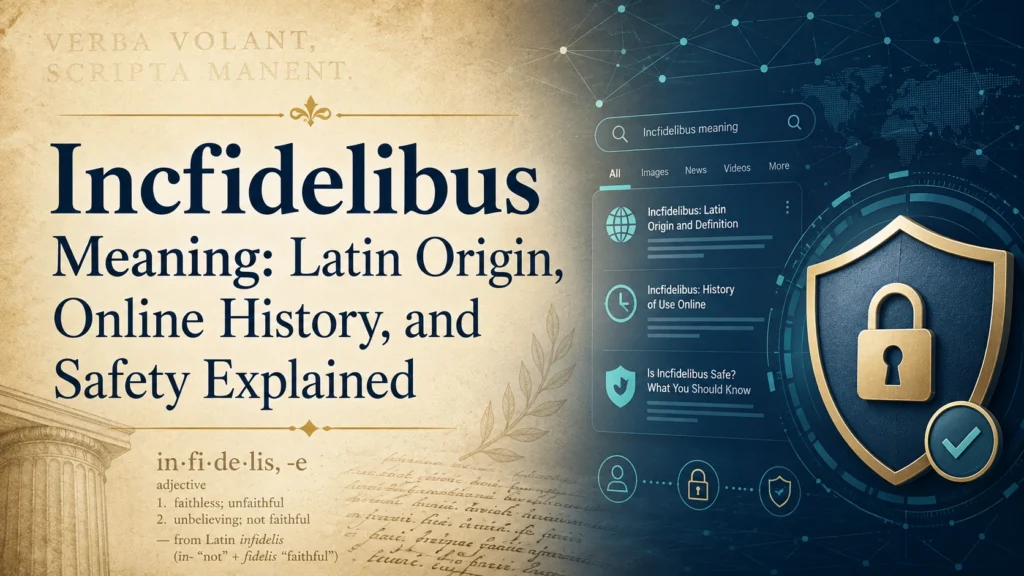
Incfidelibus: Meaning, Latin Origin, Online History, and What the Evidence Actually Shows
I became interested in incfidelibus for a simple reason: the search results surrounding this unusual word tell several different stories at once. Some pages present it as Latin, some give it philosophical interpretations, and others connect the name with hacking, phone monitoring, spam, or scams. After comparing those claims with established Latin references and publicly accessible online records, I think the most useful approach is to separate what can actually be verified from what has merely been repeated online. The documented Latin word is infidelibus, without the extra “c.” Incfidelibus, by contrast, is not established as a standard Latin form in the linguistic references I reviewed. The spelling has also developed a separate internet history, which helps explain why people continue searching for it.
Key Takeaways About Incfidelibus
The most important facts become much easier to understand once the linguistic question and the internet-history question are kept separate.
- Incfidelibus is not verified as a standard Latin word in the major Latin references I reviewed.
- Infidelibus is a genuine Latin form, spelled without the extra “c.”
- Infidelibus is the dative or ablative plural of infidelis.
- Infidelis can mean unfaithful, faithless, unreliable, or unbelieving, depending on the period and context.
- The precise English translation of infidelibus depends on the sentence in which it appears.
- The origin of the extra “c” in incfidelibus is not conclusively documented. A typo, transcription mistake, OCR error, or deliberate online spelling are all possible explanations.
- Public web archives show the Incfidelibus name being used in 2019 on content promoting alleged access to phones and messaging accounts. Those pages prove that the name was used, not that the advertised capabilities actually worked.
- Recent claims that incfidelibus is an ancient philosophy or established historical concept lack convincing support from the linguistic evidence I found.
- An unfamiliar word in an unexpected message is not proof that a device has been compromised. General phishing guidance still applies: avoid unexpected links and attachments and verify claims independently.
What Is Incfidelibus?
In my analysis, incfidelibus is best understood as a non-standard spelling that closely resembles the genuine Latin word infidelibus. That distinction is important because a one-letter difference can completely change whether a form is grammatically documented. Established Latin resources list infidelis, while standard declension information gives infidelibus as a plural form. I did not find the additional “c” supported as part of that normal Latin pattern.
Calling incfidelibus a “Latin word” without qualification therefore goes further than the evidence allows. A safer description is that it is an unusual or non-standard spelling associated with a recognizable Latin form. Someone encountering it in a copied text, online comment, username, article, or message might reasonably assume that it has an ancient linguistic origin because its structure looks Latin. Appearance alone, however, is not enough to establish a historical word.
I also would not claim that every occurrence must be an accidental typo. Once a misspelling becomes a username, domain name, brand-like label, or repeated search term, people can use it deliberately. The original appearance may have been accidental, intentional, or the result of text-processing technology. Without a traceable earliest example, assigning one definitive origin would be speculation.
Incfidelibus Meaning Versus Infidelibus Meaning
The clearest way to understand the keyword is to examine the genuine word underneath it. Latin dictionaries document infidelis as an adjective associated with being unfaithful, faithless, or unreliable. Lewis and Short also records an ecclesiastical sense associated with unbelief.
A concise dictionary description captures the basic classical meaning particularly well:
“that cannot be relied upon, unfaithful, faithless.”
Lewis and Short, A Latin Dictionary
That definition matters because it shows why modern articles can produce different English explanations without all of them necessarily referring to the same historical context. Infidelis was not limited to one narrow religious definition. Classical usage could concern reliability or faithfulness, while later religious usage could concern belief.
The genuine form infidelibus is grammatically plural. Standard declension information lists it as both the dative plural and ablative plural of infidelis. This means that translating it correctly requires more than substituting a single English word.
For example, depending on the surrounding construction, a dative use might be rendered with an idea such as “to the unfaithful” or “for the unbelieving.” An ablative construction might require “with,” “by,” “from,” or another English expression. These are illustrations of grammatical possibilities rather than universal translations. The surrounding Latin sentence decides which English wording is appropriate.
How the Genuine Latin Grammar Works
Latin communicates grammatical relationships through changes in word endings much more extensively than modern English does. That is why focusing on the ending of infidelibus helps explain both its legitimacy and the problem with incfidelibus.
Infidelis belongs to the third-declension adjective pattern. Its plural forms change according to case. The dative and ablative plural share the ending -ibus, producing infidelibus. The extra “c” seen in incfidelibus is not part of that normal declension.
Consider a simplified hypothetical example. If a Latin writer wanted an adjective referring to several unfaithful or unbelieving people in a grammatical construction requiring the dative plural, infidelibus could be the appropriate form. If another construction required the ablative plural, the written form could again be infidelibus, although the English translation would change.
That grammatical flexibility explains why translating the isolated word as exactly “unbelievers” can be too simplistic. A translator needs to know the noun being modified or substantivized use, the case required by the sentence, the relevant preposition or verb, and the historical context.
Incfidelibus and Infidelibus Compared
A direct comparison makes the distinction easier to see.
| Term | Status | Linguistic Role | Possible Meaning or Interpretation |
|---|---|---|---|
| fides | Established Latin | Noun | Faith, trust, confidence, loyalty |
| fidelis | Established Latin | Adjective | Faithful, loyal, trustworthy |
| infidelis | Established Latin | Adjective | Unfaithful, faithless, unreliable; later also unbelieving |
| infidelibus | Established Latin | Dative or ablative plural form | Translation varies by grammatical context |
| incfidelibus | Non-standard spelling in the references reviewed | No verified standard Latin grammatical role | Often interpreted online through its similarity to infidelibus |
The practical lesson from this comparison is straightforward. If someone wants the linguistic or historical meaning, infidelibus is the word that should be investigated. Incfidelibus may lead a searcher toward that word, but the two spellings should not be presented as equally established Latin forms.
Where the Meaning of Infidelis Comes From
The word family is connected with fidelis, meaning faithful or trustworthy, together with the negative prefix in-. Merriam-Webster traces English infidel through French and Latin and identifies Latin infidelis as carrying senses including “unbelieving,” with the older Latin adjective connected to being disloyal or not faithful.
Etymonline similarly traces infidel through Old French infidèle to Latin infidelis, explaining the movement from notions of unfaithfulness and unreliability toward a specifically religious meaning in later Latin and medieval usage.
I think this semantic history is important because modern English readers can easily associate words beginning with “infidel-” only with religion or romantic infidelity. Historically, the family of words concerns the broader idea of faithfulness, trust, loyalty, and its absence. Context determines which shade of meaning is active.
Historical Context Helps Explain the Religious Interpretation
Latin expressions built from this word family continued into ecclesiastical and medieval usage. One documented example is in partibus infidelium, an established Latin phrase that Merriam-Webster translates as:
“in the regions of the infidels”
Merriam-Webster
Historically, that phrase was connected with ecclesiastical titles associated with dioceses in territories no longer under the same Christian jurisdiction. It provides a useful example of how the infidel- word family acquired a specifically religious sense in later historical contexts.
The example should not be confused with incfidelibus itself. It demonstrates documented historical use of a related Latin root, not evidence that the unusual spelling with the additional “c” was an established term.
Why Incfidelibus May Look Convincingly Latin
The spelling is convincing because nearly all of its visible structure resembles genuine Latin. A reader recognizes fragments that look like in, fidel, and ibus. Even someone who has never formally studied Latin may associate fidel- with English words such as fidelity or infidelity.
This creates what I would call a linguistic plausibility effect. A word can look old, technical, or scholarly simply because it resembles authentic morphology. Once several websites repeat the same interpretation, that appearance of authenticity can become even stronger.
A hypothetical example illustrates the problem. Imagine a digitized historical document contains the accidental form “incfidelibus.” A search engine indexes it. Later, another writer encounters the spelling, assumes it is rare Latin, and publishes a definition without consulting a dictionary. A third site summarizes the second. Within a short period, the web may contain numerous pages apparently confirming one another even though they all descend from the same original mistake.
I am not saying that this exact chain has been proven for incfidelibus. It is simply an example of how uncommon spellings can acquire an artificial appearance of authority online. The actual first origin of this spelling remains uncertain based on the evidence I could verify.
Could Incfidelibus Be an OCR or Transcription Error?
OCR, or optical character recognition, converts scanned images of printed or handwritten pages into machine-readable text. It is enormously useful for digitizing historical collections, but imperfect scans, unusual typography, damaged pages, and older typefaces can produce erroneous characters.
That makes an OCR error one plausible explanation for an anomalous word. Human transcription can create the same problem. A person copying unfamiliar Latin may insert, omit, or substitute a character without realizing that the result is not a normal grammatical form.
Still, possibility should not be confused with proof. I did not find a primary source establishing a particular manuscript, scan, typist, or OCR system as the origin of incfidelibus. Therefore, the responsible conclusion is that a copying or recognition error is plausible, but the specific origin has not been conclusively established.
How Incfidelibus Developed a Separate Online History
The linguistic question is only one part of the search intent. Publicly indexed material also shows Incfidelibus being used as an online name, especially around 2019.
An archived author page on Checkmate Tracking contains numerous posts attributed to “incfidelibus” during 2019. Titles listed on that page concern accessing WhatsApp, Snapchat, WeChat, mobile phones, and spying on communications. The archive establishes that this name was publicly associated with content making those kinds of claims.
That evidence needs careful wording. A promotional page promising access to another person’s account does not prove that such access actually occurred. It also does not establish who was behind the name, whether every historical use belonged to the same operator, or whether a present-day site with a similar name has continuity with those older pages.
In my view, this distinction is essential. Online investigations become unreliable when historical association is silently converted into a stronger accusation. We can say that Incfidelibus-branded content promoted or discussed alleged phone and account access. We cannot conclude from the archive alone that every advertised service worked or that every contemporary use of the keyword should be treated as the same entity.
Incfidelibus Online Claims: What Is Verified and What Is Not
The following table separates stronger evidence from claims that deserve more caution.
| Claim | Evidence Assessment | Practical Interpretation |
|---|---|---|
| Incfidelibus is a standard Latin word | Not supported by the Latin references reviewed | Use infidelibus when discussing the genuine Latin form |
| Infidelibus is a real Latin form | Well supported | It is the dative or ablative plural of infidelis |
| Infidelis can mean unfaithful or faithless | Well supported | Classical dictionaries document these senses |
| Infidelis developed a religious sense | Well supported | Ecclesiastical and later usage includes “unbelieving” |
| The extra “c” came from OCR | Plausible but unproven | Treat it as a hypothesis, not established history |
| Incfidelibus was used online around alleged hacking or monitoring content | Supported by publicly indexed 2019 material | Historical association is documented |
| Every Incfidelibus-branded service was fraudulent | Not established by the sources reviewed | Avoid blanket conclusions without case-specific evidence |
| Incfidelibus is an ancient philosophy about loyalty or identity | No credible historical evidence found in this research | Treat such descriptions as modern interpretation unless sourced |
| An email containing the word proves a device was hacked | Unsupported | Judge the message using normal phishing and security indicators |
The key point is that different kinds of evidence answer different questions. A Latin dictionary can establish grammar. An archived website can establish that a name appeared publicly at a certain time. Neither source automatically proves every claim made by modern articles about the keyword.
What to Do If You Encounter Incfidelibus in a Document
When I encounter an unusual term that resembles an established historical word, I use a simple verification process rather than trusting the first search result.
First, copy the spelling exactly. A single character matters here because incfidelibus and infidelibus produce different conclusions.
Second, examine the surrounding sentence. If the text is Latin, the neighbouring words can reveal whether the expected form should be dative, ablative, or something else.
Third, consult a recognized dictionary or corpus. Resources based on Lewis and Short and the Scaife ATLAS material document infidelis and its meaning.
Fourth, consider the quality of the source. If the spelling occurs only in machine-scanned text, an OCR error becomes more plausible. If it appears as a username, domain, or brand-like identifier, the non-standard spelling may be intentional.
Finally, avoid translating incfidelibus as though it has one independent ancient meaning. Where the surrounding evidence points toward infidelibus, explain the correction and translate the actual Latin construction.
What to Do If Incfidelibus Appears in an Unexpected Email
A strange sender name or unfamiliar word should encourage verification, but it should not create panic. The word itself cannot establish that an email is genuine, malicious, or proof of a compromised device.
The Federal Trade Commission warns that phishing messages frequently create a story designed to make recipients click links or open attachments. Its guidance is direct:
“Don’t click on links or download attachments in these messages.”
Federal Trade Commission
I would apply that principle regardless of whether a suspicious message contains incfidelibus or any other unusual name. If the sender claims to represent a bank, service, employer, government office, or other organization, verify the claim using contact details you obtain independently rather than the phone number or link inside the message.
FTC guidance also recommends using spam filters, enabling two-factor authentication, reporting phishing messages, and deleting them after they have been checked and reported.
If a message claims that your webcam, email, phone, or social media account has been compromised, the wording of the threat is not evidence of the compromise. Check account security directly, review login activity where available, update compromised or reused passwords, and use trusted security tools rather than following instructions from the sender.
A Practical Step-by-Step Method for Checking Incfidelibus Claims
When a search result makes a dramatic claim about incfidelibus, I recommend working through the following sequence:
- Identify the exact claim. Is the page discussing Latin, history, a website, a person, cybersecurity, or philosophy?
- Look for a primary or authoritative source. Linguistic claims should point to dictionaries, corpora, manuscripts, or scholarly resources.
- Check whether the source contains the exact spelling. A source documenting infidelibus does not automatically document incfidelibus.
- Separate inference from evidence. “This could be an OCR error” is different from “this originated as an OCR error.”
- Check dates. A 2019 web page can establish use of a name in 2019, but not necessarily its origin.
- Avoid assuming identity continuity. Domains, usernames, and websites can change operators.
- Treat extraordinary claims cautiously. Claims about secret hacking tools, guaranteed account access, or invisible monitoring deserve especially strong evidence.
- Use normal digital-safety practices. Do not provide passwords, authentication codes, financial information, or device access merely because an unfamiliar sender uses technical-sounding language.
This process is useful beyond one keyword. It is a practical way to investigate any obscure term whose search results mix genuine scholarship with copied articles, marketing material, historical web pages, and speculation.
Common Misconceptions About Incfidelibus
One misconception is that an unfamiliar Latin-looking word must have an ancient philosophical meaning. Languages do not work that way. A string of letters can resemble authentic morphology while still being a typo, invented name, or modern variation.
Another misconception is that infidelibus always translates as “unbelievers.” That rendering may fit some religious contexts, but classical infidelis also deals with unreliability and unfaithfulness. Grammar further changes how infidelibus should be represented in English.
A third misconception is that the root automatically refers to romantic infidelity. Modern English strongly associates “infidelity” with relationships, but the Latin word family is older and broader. Merriam-Webster’s etymology traces infidelis through concepts of faithfulness, loyalty, and unbelief.
A fourth misconception is that historical online content using the name proves every modern occurrence is dangerous. Historical association is worth knowing, but responsible research does not transfer an allegation automatically from one page, operator, or time period to every later use of the same string.
Finally, there is a tendency to treat a large number of search results as proof. Search volume and repetition measure visibility, not historical accuracy. Ten pages repeating the same unsupported statement are not equivalent to one primary source proving it.
How I Recommend Writing or Using the Term
If I were editing academic, historical, linguistic, or educational material, I would use infidelibus when that is the grammatically intended Latin form.
If the source document itself contains incfidelibus, I would preserve the spelling when quoting it but identify it as a non-standard form or probable error where the evidence supports that interpretation. Correcting a historical transcription silently can hide useful information about the source.
For creative writing, usernames, fictional organizations, art, or branding, a writer can of course deliberately use incfidelibus. In that setting, however, the term should not be described as authentic classical Latin unless independent evidence supports the claim.
The same caution applies to symbolic interpretations. A modern writer might intentionally assign ideas of mistrust, betrayal, loyalty, belief, or uncertainty to the spelling because of its resemblance to infidelis. That can be a legitimate creative interpretation. It should simply be presented as a modern interpretation rather than an ancient dictionary definition.
Why Search Results for Incfidelibus Can Become Confusing
Obscure keywords create an unusual search environment. When reliable reference material contains little or nothing about the exact spelling, publishers may try to fill the gap by interpreting what the term “might” mean.
Once several pages exist, later writers can mistake those pages for independent corroboration. If each article ultimately relies on another unsourced article, the apparent consensus is weaker than it looks.
The better approach is to move one level deeper. For incfidelibus, that means researching infidelis, infidelibus, standard Latin declension, dated online archives, and established cybersecurity guidance separately. Those sources let us reconstruct a cautious explanation without inventing a single dramatic story that supposedly connects everything.
I believe this is why the keyword is more interesting than a simple typo. It demonstrates how language, search engines, web archives, modern security concerns, and content repetition can combine around one unusual string of letters.
Expert Recommendations for Interpreting Incfidelibus Responsibly
My first recommendation is to distinguish linguistic identity from online identity. The resemblance between incfidelibus and infidelibus explains the linguistic discussion. Historical uses of “Incfidelibus” as an online name belong to a separate evidence trail.
Second, use dictionary definitions conservatively. Lewis and Short supports meanings such as unfaithful and faithless and notes a later ecclesiastical sense. It does not justify assigning a new philosophical doctrine to the altered spelling.
Third, preserve uncertainty where uncertainty genuinely exists. I think saying “the extra letter may be a typo or transcription error” is stronger scholarship than confidently inventing a date and origin that cannot be demonstrated.
Fourth, evaluate security claims according to behaviour rather than vocabulary. Unexpected payment requests, demands for credentials, suspicious attachments, pressure to act immediately, and requests to bypass normal verification procedures matter far more than whether a message contains an exotic-looking name.
Finally, use primary or authoritative material whenever possible. A dictionary should support the linguistic claim, an archive should support a historical web claim, and an agency such as the FTC should support general phishing advice. That source discipline prevents unrelated claims from being blended into one misleading narrative.
Why the Difference Between One Letter Matters
It is tempting to dismiss the extra “c” as trivial, but spelling matters considerably in linguistic research. Inflected languages such as Latin encode grammatical information systematically. Adding an unsupported letter can turn a recognizable form into something the established paradigm does not explain.
The difference also matters for search intent. Someone searching for “infidelibus” may be translating Latin. Someone searching for “incfidelibus” may instead be investigating an unfamiliar web name, copied spelling, suspicious message, or recently published article.
This is why I would not simply redirect every searcher to a one-line definition. The most complete answer has to explain both the documented Latin form and the separate digital use of the unusual spelling.
Conclusion
I believe the strongest evidence-based explanation of incfidelibus is less mysterious than many search results make it sound. The exact spelling is not established as a standard Latin word in the major references I reviewed. The authentic linguistic form is infidelibus, the dative or ablative plural of infidelis, a Latin adjective associated with unfaithfulness, unreliability, faithlessness, and, in later religious contexts, unbelief.
At the same time, Incfidelibus has acquired an independent digital footprint. Publicly indexed material shows the name being used in 2019 around content that promoted alleged phone and messaging-account access. That history deserves caution, but it should not be exaggerated into claims that the evidence cannot prove.
My practical advice is simple: identify which subject you are actually investigating. For Latin, research infidelibus and examine the surrounding sentence. For an email, website, username, or online service using Incfidelibus, evaluate the specific source on its own evidence and follow ordinary cybersecurity precautions. Most importantly, do not let repeated web claims replace verification.
Frequently Asked Questions
What Does Incfidelibus Mean?
Incfidelibus does not have a securely established independent meaning in the standard Latin references I reviewed. It closely resembles infidelibus, which is a genuine form of the Latin adjective infidelis. That adjective can mean unfaithful, faithless, unreliable, or, particularly in ecclesiastical Latin, unbelieving. Because infidelibus is a dative or ablative plural form, its exact English translation depends on the surrounding sentence rather than one fixed definition.
Is Incfidelibus a Real Latin Word?
I could not verify incfidelibus, with the extra “c,” as a standard Latin form in the established references reviewed for this article. The documented word is infidelibus. Latin declension information identifies that spelling as the dative and ablative plural of infidelis. Therefore, anyone describing incfidelibus as an established classical or medieval Latin word should provide a credible primary source supporting that exact spelling.
What Is the Correct Spelling, Incfidelibus or Infidelibus?
If the intended word is the recognized Latin grammatical form, infidelibus is the correct spelling. The form comes from infidelis and does not contain a “c” between “in” and “fidelibus.” Incfidelibus may still appear intentionally as a modern name, username, domain, or creative spelling, so it should not be automatically corrected when quoting a source that deliberately uses it.
What Does Infidelibus Mean in English?
Infidelibus can relate to people or things characterized as unfaithful, faithless, unreliable, or unbelieving, but there is no single English translation appropriate for every occurrence. Grammatically, it is the dative or ablative plural of infidelis. Depending on the sentence, English may require constructions involving ideas such as “to,” “for,” “with,” “by,” or “from.” A full translation therefore needs the surrounding Latin context.
Is Incfidelibus Connected With Hacking?
There is documented historical online material connecting the Incfidelibus name with content about alleged access to phones and messaging accounts. An indexed 2019 author archive includes posts concerning WhatsApp, Snapchat, WeChat, mobile phones, and related monitoring topics. That establishes historical use of the name, but it does not prove that any advertised hacking capability worked or that every current use of Incfidelibus belongs to the same operator.
Is Incfidelibus a Scam?
The available evidence does not justify labeling every person, website, message, or current use of the term incfidelibus as a scam. Historical online material gives readers a reason to investigate carefully, particularly when the term appears alongside promises of unauthorized account or phone access. The safer approach is to evaluate the specific service, payment request, sender, domain, and claim rather than making a universal allegation based solely on a name.
Is Incfidelibus an Ancient Philosophy?
I found no strong linguistic, academic, or historical evidence establishing incfidelibus as the name of an ancient philosophical movement. Modern pages may assign ideas such as loyalty, betrayal, identity, trust, or belief to the term because it resembles infidelis. Those interpretations can exist as modern creative concepts, but they should not be presented as documented ancient history without primary evidence.
Could Incfidelibus Be an OCR Error?
Yes, an OCR error is plausible, but it is not proven as the definitive origin. Optical character recognition can misread older fonts, damaged scans, or unfamiliar language. Human transcription errors are also possible. However, I did not find a traceable primary source proving exactly when, where, or how the additional “c” first appeared. The most accurate wording is therefore that a typo, OCR problem, transcription error, or deliberate modern spelling could explain it.
Should I Worry If Incfidelibus Appears in an Email?
The word alone does not prove that your account or device has been compromised. Evaluate the message using ordinary phishing precautions. The FTC advises against clicking unexpected links or downloading attachments and recommends contacting the supposed organization through contact information you independently know to be genuine. If a message claims your account was hacked, check account activity directly and update security settings rather than following the sender’s instructions.
Can Searching for Incfidelibus Harm My Device?
Simply typing and searching a word is not itself evidence of a security compromise. Risk depends on what websites you visit, what files you download, what links you follow, and what information or permissions you provide. Avoid suspicious downloads, unexpected software installations, credential requests, and unsolicited attachments. The same basic safety rules that apply to other unfamiliar websites and messages apply here.
Sources and References
- Lewis and Short, A Latin Dictionary, via the Berlin-Brandenburg Academy’s Classical Language Dictionary, entry for infidelis.
- Scaife ATLAS / Perseus Digital Library, entry for infidelis.
- Wiktionary Latin declension table for infidelis, documenting infidelibus as dative and ablative plural and citing major Latin dictionaries.
- Merriam-Webster, infidel etymology and definition.
- Merriam-Webster, in partibus infidelium.
- Online Etymology Dictionary, history of infidel.
- Federal Trade Commission, phishing-scam guidance.
- Checkmate Tracking author archive, publicly indexed historical posts attributed to “incfidelibus” during 2019.
Disclaimer
I have prepared this article for general informational and educational purposes. Linguistic interpretations can depend on the complete historical text and grammatical context, while online identities, domain ownership, and websites can change over time. References to historical web content describe what publicly accessible records show and should not be interpreted as a legal judgment about any person, company, current website, or present-day operator. For suspected fraud, compromised accounts, or cybersecurity incidents, use trusted security channels and appropriate official reporting resources.