Woeken Meaning: Origin, Dutch Roots, and Modern Online Uses
I first approached woeken as though it might be another newly invented internet term, but the linguistic evidence makes the story more interesting. Current search results give the word several competing definitions. Some websites describe woeken as a productivity term for deep, focused work. Others call it an invented digital word, a brandable expression, or a possible misspelling of “woken.” Historical Dutch lexicographic material, however, shows that the form is not purely a creation of the modern internet. The Middelnederlandsch Woordenboek records historical evidence connected with “woeken” within its entry for the Dutch verb woekeren. At the same time, that history does not prove that people using “woeken” online in 2026 are consciously using the older Dutch word. In my analysis, the most accurate explanation requires us to separate historical Dutch usage, modern English confusion, and recently invented online interpretations.
Key Takeaways About Woeken
The evidence becomes much clearer when historical language and modern internet usage are treated as separate subjects.
- Woeken has historical Dutch evidence, so it should not automatically be dismissed as a meaningless sequence of letters.
- The Middelnederlandsch Woordenboek discusses an attested “woeken” form within its entry for woekeren.
- The modern Dutch form most clearly documented by linguistic sources is woekeren, which historically covers ideas involving interest, increase, growth, spreading, and accumulation.
- Woeken is not the English word “woken.” Cambridge and Merriam-Webster identify woken as the past participle of wake.
- Recent websites disagree sharply about the modern meaning of woeken. Some call it a productivity concept, while another describes it as technology for creating short videos. This inconsistency is a reason to treat those definitions cautiously.
- There is not enough evidence to claim that the historical Dutch form directly created the modern internet keyword.
- Context remains essential. Woeken in a historical Dutch text may require a completely different interpretation from Woeken used as a username, domain, project name, or contemporary online expression.
What Does Woeken Mean?
The safest answer is that woeken does not have one universal meaning across every context. Historically, it has evidence within Dutch language material related to the word family represented today by woekeren. In contemporary English-language web content, however, “woeken” has become an ambiguous keyword to which different writers assign very different definitions.
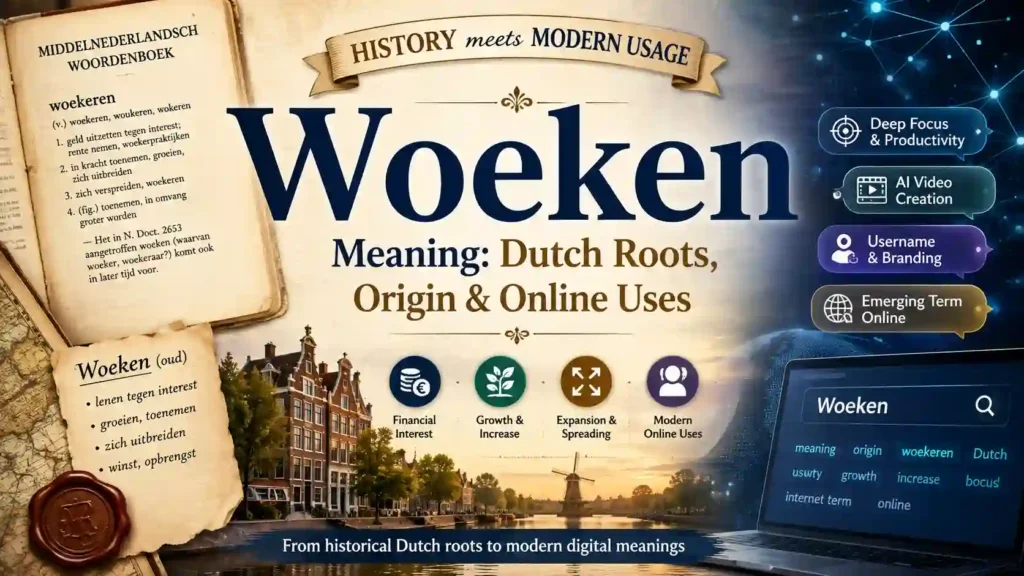
The Dutch historical connection is more substantial than many recent online explanations acknowledge. The Institute for the Dutch Language’s Middelnederlandsch Woordenboek has an entry for woekeren and explicitly discusses the form woeken. The historical meanings associated with this word family include lending or receiving money at interest, increasing, expanding, and growing in size or strength. The entry also contains usages involving capital producing returns and something spreading or becoming larger.
That does not mean every modern search for woeken should be translated as “to grow” or “to charge interest.” Historical language changes, spelling changes, and words can independently become usernames or invented digital labels. I think the strongest answer therefore has two parts: woeken has genuine historical Dutch evidence, but the modern online keyword has no single demonstrated English definition.
Is Woeken a Real Word?
Calling woeken either completely “real” or completely “fake” oversimplifies the evidence.
If the question is whether woeken has appeared historically as a Dutch linguistic form, the answer is yes. The Middle Dutch dictionary maintained through the Institute for the Dutch Language explicitly notes historical occurrences of the form within its discussion of woekeren.
If the question instead means, “Is woeken a standard modern English word with the widely accepted meaning given by recent blogs?” the answer is much less certain. Current web pages assign conflicting definitions, and the established English dictionaries I checked instead document the similar-looking form woken as a grammatical form of wake.
This distinction matters. A historical spelling can be legitimate within one language and period while failing to function as a standard modern English term. Similarly, a modern username or brand can deliberately use an old-looking spelling without adopting its historical meaning.
The Historical Dutch Roots of Woeken
The strongest linguistic evidence I found comes from the Middelnederlandsch Woordenboek, or Middle Dutch Dictionary, available through the Institute for the Dutch Language. Its main modern lemma is woekeren, and it gives older variants including forms such as woukeren and wokeren. It also links the word family to older Germanic forms.
One sentence in the dictionary is particularly important because it directly addresses our target spelling:
“Het in N. Doct. 2653 aangetroffen woeken (waarvan woeker, woekeraar?) komt ook in later tijd voor.”
Middelnederlandsch Woordenboek, Institute for the Dutch Language
In practical terms, the dictionary is noting that a form spelled woeken was encountered in historical material and also appeared later. This is much stronger evidence than simply saying the spelling “looks Dutch.”
I would still use the evidence carefully. The dictionary’s modern headword is woekeren, not woeken. That tells us that modern explanations should not simply replace woekeren with woeken and pretend that the forms are interchangeable in current Dutch.
The historical entry gives several semantic directions for woekeren. These include lending at interest, receiving interest, increasing in power, expanding in size, and capital increasing through returns. The word family therefore developed around concepts of increase, gain, accumulation, and sometimes excessive or morally questionable profit.
How Woeken Relates to Woekeren and Woeker
Understanding the related Dutch words makes the history easier to follow.
The modern Dutch word family includes woekeren, while nouns and compounds derived from the same family continue to carry ideas of excessive profit or uncontrolled increase. For example, the Institute for the Dutch Language’s modern ANW entry for woekerwinst defines it as an excessively large profit and specifically identifies woekeren as part of the word’s formation.
Another ANW entry, woekering, identifies woekeren as its base verb. That contemporary grammatical documentation supports the point that woekeren, rather than woeken, is the form that remains structurally productive in modern Dutch.
Historically, the concept did not remain limited to finance. The Middle Dutch dictionary records uses involving something increasing in strength or spreading in extent. That explains why related Dutch vocabulary can carry imagery of uncontrolled growth as well as financial exploitation.
I think this broader semantic history is one reason modern writers can find the word attractive. A term associated with growth, spreading, increase, or accumulation can easily be reinterpreted for business, productivity, technology, creativity, or digital culture. Such a reinterpretation, however, would be a modern development rather than automatic proof of the historical meaning.
Woeken, Woekeren, Woken, and Woke Compared
The spelling similarities make these words easy to mix up, but they should not be treated as synonyms.
| Term | Language or Context | Documented Status | Basic Meaning or Function |
|---|---|---|---|
| woeken | Historical Dutch and modern online use | Historically attested form, modern online meaning varies | Historically connected with the woekeren word family |
| woekeren | Dutch | Established verb | Historically associated with interest, increase, expansion, spreading, or accumulation |
| woeker | Dutch | Established related word | Connected with excessive gain, usury, or profit |
| woken | English | Standard English form | Past participle of wake |
| woke | English | Standard English form | Past tense of wake and also an adjective concerning social awareness |
| waken | English | Standard English verb | To wake or cause someone to wake |
The most important takeaway is that similar spelling does not establish shared meaning. Cambridge explicitly identifies woken as the past participle of wake, while its entry for woke separately describes the past-tense form and the modern adjective.
Woeken Is Not the Same as Woken
One of the easiest explanations for a modern occurrence of woeken is a spelling mistake for woken, but that possibility depends on context.
Cambridge gives the definition of woken very simply:
“past participle of wake”
Cambridge Dictionary
Merriam-Webster gives the same grammatical identification. The ordinary English construction is therefore something such as, “I have woken up,” not “I have woeken up.”
Suppose someone writes, “She had woeken before sunrise.” In that specific sentence, correcting the word to woken would make strong grammatical sense.
Now consider a different sentence: “Woeken is the name of our new digital project.” In that case, changing it to woken would be unjustified because the writer may intentionally be using Woeken as a proper name.
Context tells us whether we are looking at an English spelling error, a historical word, or a deliberately created label.
Is Woeken Related to Woke?
I would not automatically connect woeken with woke.
Cambridge documents woke in English both as the past simple form of wake and as an adjective relating to awareness of social problems such as racism and inequality.
Woeken contains similar letters, which can encourage people to imagine a connection involving awakening or consciousness. Some recent online explanations do exactly that. Yet similarity in spelling does not establish etymology.
For a historical relationship to be convincing, I would expect evidence from etymological dictionaries, dated texts, or documented development from one form into another. I did not find evidence showing that the historical Dutch woeken form derives from the contemporary English adjective woke. The historical Dutch evidence is much older and belongs to a different linguistic development.
The Modern Online Meaning of Woeken Is Much Less Certain
The modern search landscape becomes especially interesting because recently published pages disagree about what woeken supposedly means.
One 2026 article describes Woeken as a modern internet term associated with “deep, distraction-free focus” and suggests that people use it for concentrated working sessions.
Another recent article makes a completely different claim. It says Woeken refers to a way of turning written ideas into short videos using computer technology.
Other pages say there is no fixed definition at all and suggest possibilities including a typo, username, brand, or invented internet term.
When several recent articles provide mutually incompatible definitions, I do not think it is responsible to select whichever one sounds most interesting and present it as established fact.
Instead, the inconsistency itself becomes evidence. It suggests that woeken has not developed one clearly standardized modern English meaning.
Does Woeken Mean Deep Focus or Productivity?
Some of the strongest recent search-result visibility comes from pages associating woeken with productivity.
Under this interpretation, “woeken mode” supposedly describes a period of highly concentrated work without notifications, multitasking, or digital distractions. The idea resembles familiar concepts such as flow or focused work.
What I could not verify is the claim that this definition emerged organically from a clearly identifiable community before websites began publishing articles explaining it.
That distinction is important.
A term becomes meaningful slang because people actually use it within communities and understand what other users mean. A collection of websites defining the same unusual keyword does not necessarily prove that such community adoption has occurred.
For example, if hundreds of independent users were using “woeken mode” naturally in dated discussions before explanatory articles appeared, that would provide stronger evidence of organic slang development. By contrast, if most visible evidence consists of sites explaining the supposed meaning to searchers, the situation is less clear.
My recommendation is therefore to describe “deep focus” as one modern online interpretation of woeken, not its definitive established meaning.
Could Woeken Be an Internet-Created Word?
Yes, some modern uses of Woeken may be independently invented even though historical Dutch evidence exists.
This might sound contradictory, but it is common in language. The same sequence of letters can arise more than once for unrelated reasons.
Imagine that someone creates a username “Woeken” because the domain is available and the spelling looks memorable. That person may have no knowledge of Middle Dutch vocabulary. Their Woeken is technically a modern naming choice even though an identical historical form existed centuries earlier.
A startup could do the same thing. So could a game developer, musician, social media user, fictional writer, or software creator.
This distinction between same spelling and same origin is crucial. Historical documentation establishes that the letters W-O-E-K-E-N have linguistic precedent. It does not establish a direct genealogical connection between every later appearance of those letters.
Why Woeken Works Well as a Digital Name
From a branding perspective, I can see why the spelling attracts attention even without assigning it a new dictionary definition.
Woeken is short, visually distinctive, and easy to search as an exact string. It looks vaguely Germanic to English-speaking readers because of its “oe” combination and “en” ending. At the same time, it is uncommon enough in English that it stands out.
Those qualities can make an unusual word attractive for usernames and digital projects.
The historical semantic associations may add another layer for someone who deliberately knows the Dutch background. Ideas such as growth, increase, spreading, accumulation, or making gains could be useful metaphorically in branding.
But I would distinguish between possible branding associations and historical dictionary definitions. A modern company can redefine a name for its own purposes. That new brand meaning does not rewrite the older linguistic record.
Different Woeken Claims and How Strong the Evidence Is
The following comparison helps separate documented information from modern interpretations.
| Claim About Woeken | Evidence Strength | My Assessment |
|---|---|---|
| Woeken has historical Dutch evidence | Strong | Supported by the Middle Dutch Dictionary |
| Woeken is related to the Dutch woekeren word family | Strong in historical lexicographic context | Supported by Dutch language sources |
| Woeken means “woken” in English | Context-dependent | It may be a typo in some sentences, but the words are not automatically equivalent |
| Woeken means deep focused work | Limited | A recent online interpretation, not a clearly established dictionary meaning |
| Woeken is an AI video technology concept | Weak as a general definition | One recent site makes this claim, but it conflicts with others |
| Woeken means awakening or social awareness | Weak | Resemblance to woke does not establish a historical relationship |
| Woeken is completely invented in 2026 | Contradicted by historical evidence | Older Dutch lexicographic material documents the form |
| Every modern use comes from Dutch | Unproven | Modern users may independently adopt the spelling |
| Woeken can be a username or brand name | Plausible and observable as a naming practice | Meaning must be determined from the specific source |
I believe the table shows why neither extreme works. Calling woeken a completely meaningless AI-era invention ignores historical evidence. Giving it one trendy 2026 definition ignores the inconsistency of current online usage.
How to Determine What Woeken Means in Context
When I encounter woeken in an unfamiliar source, I would identify the context before trying to define it.
| Step | What to Check | Why It Matters |
|---|---|---|
| 1 | Read the complete sentence | Grammar may reveal whether “woken” was intended |
| 2 | Identify the language | Dutch historical material needs different analysis from modern English |
| 3 | Check whether Woeken is capitalized | Capitalization may indicate a name, project, account, or brand |
| 4 | Examine the publication date | Medieval, historical, and 2026 uses should not be interpreted identically |
| 5 | Look for the author’s own definition | A creator may deliberately assign a custom meaning |
| 6 | Compare with established dictionaries | This helps distinguish documented vocabulary from speculative definitions |
| 7 | Check earlier dated uses | Earlier evidence can test claims about a word’s supposed origin |
| 8 | Preserve uncertainty when necessary | An unknown origin is better than an invented one |
For a historical document, I would start with Dutch lexical resources such as those maintained by the Institute for the Dutch Language. For an English sentence involving sleep, I would test whether woken makes grammatical sense. For a modern brand or username, I would look for the creator’s explanation rather than assuming a dictionary meaning.
Why Recent Search Results Can Make Woeken Confusing
Search engines are designed to identify relevant pages, not to decide automatically which linguistic theory is historically correct.
An unusual keyword creates a special problem. When relatively little authoritative material directly targets that exact spelling, newly published pages can occupy a large share of the search results.
Once one interpretation appears, later pages may repeat it.
This can create what looks like consensus even when the underlying evidence is thin. If five websites all say woeken means “deep productivity,” a reader may naturally assume that five independent sources confirmed the definition. In reality, the sites might be drawing from one another, responding to the same keyword trend, or independently generating explanations from the same limited search landscape.
The conflicting current definitions reinforce that concern. One set of pages describes focus and productivity, while another describes AI-assisted short-video creation.
That is why I give historical linguistic sources more weight when making historical claims.
Common Misconceptions About Woeken
A common misconception is that woeken has no linguistic history whatsoever. The Middle Dutch dictionary evidence makes that statement too strong. The exact form has historical documentation within the discussion of woekeren.
Another misconception is that historical existence automatically determines modern meaning. It does not. Someone creating a social account named Woeken in 2026 may have invented the name independently.
The third misconception is that woeken must mean woken because the spellings are close. In an English sentence about waking from sleep, that correction may be right. In other contexts it may destroy the intended meaning.
The fourth is that woeken has already become an established productivity term. Several websites promote that interpretation, but the evidence I reviewed does not establish it as a standardized English definition.
The fifth misconception is the opposite claim that every productivity interpretation is automatically invalid because the term has older Dutch roots. Language can acquire new meanings. The appropriate question is whether there is evidence of meaningful adoption, not whether the word had a previous life.
Can You Use Woeken in English Writing?
You can use Woeken intentionally, but I would avoid treating it as ordinary standard English without explaining what you mean.
For formal writing, clarity matters more than novelty. If you mean woken, write woken. If you mean the Dutch verb woekeren, use the documented Dutch form appropriate to the sentence. If Woeken is a brand, product, username, fictional name, or defined concept, preserve the intended spelling and explain it when readers need context.
Suppose a writer creates a productivity framework called “The Woeken Method.” That name can function perfectly well as a proper noun. The author would simply need to define what the method means rather than suggesting that an English dictionary already recognizes the definition.
A similar principle applies in fiction. A novelist might call a city, organization, character, or technology Woeken. That is creative naming, not a linguistic error.
Should Writers Correct Woeken to Woken?
Only when context provides a good reason.
Consider the sentence, “I had woeken up three times during the night.” English grammar makes the intended correction obvious. Cambridge identifies woken as the past participle of wake, so “I had woken up” is the standard construction.
Now consider, “Her online username is Woeken.” Correcting that to Woken could be completely wrong.
Editors should therefore avoid mechanical replacement.
The same caution matters for historical documents. An editor transcribing a source should normally preserve the original historical spelling or clearly indicate an editorial correction. Silently modernizing a form can remove evidence that matters to linguistic researchers.
Does Woeken Mean Uncontrolled Growth?
There is a legitimate historical reason people associate the word family with growth and spreading, but the exact wording matters.
The Middle Dutch woekeren entry includes senses involving becoming greater in strength and expanding in size. It also describes capital increasing or producing returns.
Modern Dutch derivatives preserve related associations. The ANW documents woekerwinst as excessively large profit and identifies its relationship with woekeren.
Therefore, saying that the broader woeker/woekeren word family can involve excessive increase or spreading is evidence-based.
Saying that every contemporary use of woeken specifically means “uncontrolled growth” would be too strong. Historical relationship and present-day definition are different claims.
Why the Financial Meaning Matters
The financial side of the word family is especially old.
The Middle Dutch dictionary contains meanings concerning lending money at interest, taking interest, and capital growing through returns. Some historical examples have negative moral associations connected with usury.
This background helps explain modern Dutch compounds connected with excessive profit.
It also shows why reducing the entire history to the trendy idea of “productivity” loses important context. The older semantic field includes money, gain, increase, growth, spreading, and moral judgments about excessive enrichment.
In my view, this older history is far more interesting than inventing a neat one-line origin story.
What Woeken Tells Us About Language on the Modern Internet
Woeken provides a useful case study in how search engines can influence our perception of language.
Before mass digital publishing, an obscure historical spelling might remain confined to dictionaries, archives, or specialist scholarship. Today, a short unusual string can become a search keyword, domain, social handle, article topic, and supposed trend almost simultaneously.
Publishers then face pressure to answer a question such as “What does woeken mean?” even when the evidence does not provide one simple answer.
Some may resolve that uncertainty by creating a definition that sounds plausible. Others copy interpretations already ranking in search results. Eventually, repetition can make a speculative meaning feel established.
Yet real language development can happen online too. Memes, community slang, software terminology, gaming language, and social-media expressions genuinely produce new vocabulary.
The challenge is distinguishing authentic adoption from explanation-first content where websites define a term before there is evidence that a community actually uses it that way.
With woeken, I think the right answer is to keep observing usage while preserving the historical record we already have.
How I Would Define Woeken in 2026
If I needed a concise but careful definition today, I would write:
Woeken is a historically attested Dutch form associated with the word family of woekeren, involving ideas such as increase, interest, growth, or spreading. In modern English-language internet usage, Woeken is also an ambiguous term used or interpreted as a name, spelling variation, or emerging concept, without one universally established contemporary definition.
That definition avoids two mistakes.
First, it does not erase the historical Dutch evidence. Second, it does not pretend that recent internet interpretations have already become settled language.
I believe this is more useful to a reader than confidently assigning Woeken whichever definition happens to be popular on a particular blog.
Conclusion
I see woeken as a good example of why unusual internet keywords deserve careful research rather than instant definitions. Historical Dutch evidence shows that the spelling is not simply a random invention from 2026. The Middelnederlandsch Woordenboek explicitly records a historical woeken form in connection with woekeren, whose documented meanings include financial interest, increase, expansion, and growth.
Modern online usage is much less settled. Recent websites variously describe Woeken as deep-focused productivity, a flexible digital expression, a brand-like term, or even an AI video concept. Those conflicting explanations demonstrate why I would not present any one of them as the official modern definition.
The practical lesson is to identify the context first. Historical Dutch usage should be interpreted through Dutch linguistic evidence. An English sentence about waking may simply contain a misspelling of woken. A username, company, or modern concept may use Woeken deliberately and define it independently. When the context remains unclear, preserving that uncertainty is more accurate than inventing certainty.
Frequently Asked Questions
What Does Woeken Mean?
Woeken has more than one possible interpretation depending on context. Historical Dutch lexicographic evidence records the form in connection with woekeren, a word family associated with financial interest, increase, expansion, and growth. Modern English-language websites also use or describe Woeken in several different ways, but those contemporary explanations are inconsistent. For that reason, I would not assign one universal modern definition without first checking where the term appears.
Is Woeken a Real Word?
Woeken has genuine historical linguistic evidence, so calling it completely fabricated would be inaccurate. The Middle Dutch Dictionary explicitly discusses an attested form spelled woeken within its entry for woekeren. That does not automatically make woeken a standard contemporary English word or mean that every current use carries the historical Dutch meaning. Language, period, and context still determine the correct interpretation.
Is Woeken a Dutch Word?
Woeken has historical Dutch documentation, although the modern dictionary form most clearly associated with the word family is woekeren. The historical dictionary material links woekeren with activities involving interest, growth, increase, expansion, and accumulation and specifically notes occurrences of woeken. Therefore, describing woeken as having Dutch historical roots is reasonable, while treating it as the normal modern Dutch infinitive would be less precise.
Is Woeken the Same as Woken?
No. Woken is a standard English grammatical form, while woeken has a different linguistic history and ambiguous modern usage. Cambridge and Merriam-Webster identify woken as the past participle of wake. In a sentence such as “I had woeken up,” woeken would probably be a spelling error. However, if Woeken is a username, historical form, or proper name, automatically replacing it with woken could be incorrect.
Does Woeken Mean Deep Work?
Some recent websites use woeken to describe concentrated, distraction-free work, but I found insufficient evidence to treat that as an established dictionary definition. It is better described as a modern online interpretation. A new slang meaning could eventually become widely recognized if communities consistently adopt it, but current search results alone do not demonstrate that level of standardization.
Does Woeken Mean Growth?
The historical Dutch word family connected with woeken does include meanings involving increase, expansion, and spreading. The Middle Dutch Dictionary records senses of woekeren involving becoming greater in strength, spreading in extent, and capital growing through returns. Therefore, there is historical support for a connection with growth. However, “growth” should not automatically be assumed to be the meaning of every modern appearance of Woeken.
Is Woeken Related to Money or Usury?
Historically, yes, the related Dutch woekeren word family has strong financial associations. The Middle Dutch Dictionary records meanings involving lending or receiving money at interest, while modern related terms such as woekerwinst concern excessively large profit. This financial history is one important part of the word family’s development, although later and figurative senses also involve increase and spreading.
Is Woeken Related to Woke?
There is no evidence in the sources I reviewed establishing the modern English adjective woke as the origin of historical woeken. Cambridge defines woke as both the past tense of wake and, in another sense, an adjective concerning awareness of social problems. The historical Dutch evidence for woeken belongs to an older and separate word family, so spelling resemblance alone should not be treated as proof of etymological connection.
Why Is Woeken Appearing Online?
Woeken is appearing in recent articles partly because its meaning is unclear enough to attract curiosity. Published pages now offer several incompatible explanations, ranging from focused productivity to general digital terminology and AI-assisted video creation. This variation suggests that online interest may be developing faster than a standardized meaning. The term may also appear independently as a username, brand, project name, or deliberate creative spelling.
How Should I Use Woeken in Writing?
Use woeken only when the context supports that exact spelling. In historical Dutch discussion, preserve the source form and explain its relationship with woekeren. In standard English sentences about waking from sleep, the intended word may instead be woken. For a brand, username, fictional name, or newly defined concept, Woeken can be used deliberately, but explaining the intended meaning will help prevent readers from confusing it with established English or Dutch vocabulary.
Sources and References
Institute for the Dutch Language, Middelnederlandsch Woordenboek: Historical woekeren entry documenting older variants, meanings involving interest and growth, and the occurrence of the form woeken.
Institute for the Dutch Language, Algemeen Nederlands Woordenboek: Entries for woekering and woekerwinst, documenting their formation from woekeren and the modern word family’s continued use.
Cambridge Dictionary: Entries for woken, wake, waken, and woke, used to distinguish established English forms from woeken.
Merriam-Webster: Entry identifying woken as the past participle of wake.
Recent online usage sources: Current 2026 articles were reviewed to identify competing modern claims about woeken, including productivity and technology interpretations. These sources are used as evidence of online claims rather than as authoritative linguistic proof.
Disclaimer
I have prepared this article for general informational and linguistic purposes. Historical spelling, meaning, and grammar can vary by period, region, manuscript, and editorial interpretation. Modern uses of Woeken as a username, brand, project, slang expression, or online concept may be unrelated to historical Dutch usage. Where current online sources disagree, I have identified those interpretations as claims rather than presenting them as established linguistic facts.