Messagenal: Meaning, Principles, Uses, and the Truth Behind the Emerging Communication Term
I came across the word messagenal in a context where its meaning was far less settled than many online explanations suggest. Some pages describe it as a communication philosophy, others present it as a framework for clearer digital messaging, and a few even describe it as a software platform. After examining the available information, I believe the most useful way to understand messagenal is not as an established product or formally recognized academic theory, but as an emerging label for intentional, clear, context-aware digital communication. That distinction matters because good communication advice can still be valuable even when the terminology surrounding it is new or uncertain. In this guide, I will separate what can reasonably be supported from what remains unverified, then show how the practical ideas associated with messagenal can be applied to email, workplace chat, customer communication, remote collaboration, and everyday digital conversations.
Key Takeaways About Messagenal
Before examining the subject in detail, I think these are the points readers should keep in mind:
- Messagenal does not currently have one authoritative, universally accepted definition.
- Recent online articles commonly use the term to describe clearer, more intentional, audience-aware digital communication.
- Public evidence does not clearly establish Messagenal as a major standalone messaging application or recognized collaboration platform.
- The underlying communication ideas associated with the term are consistent with established plain-language guidance: make the purpose clear, put important information early, reduce unnecessary wording, and write for the reader.
- Messagenal can be treated as a practical framework rather than a formal scientific model.
- The concept is most useful when it encourages people to think about what the recipient needs to understand or do.
- Clear communication does not always mean extremely short communication. Context must be sufficient for the recipient to act correctly.
- Readers should distinguish the communication concept from websites or products using similar names.
What Is Messagenal?
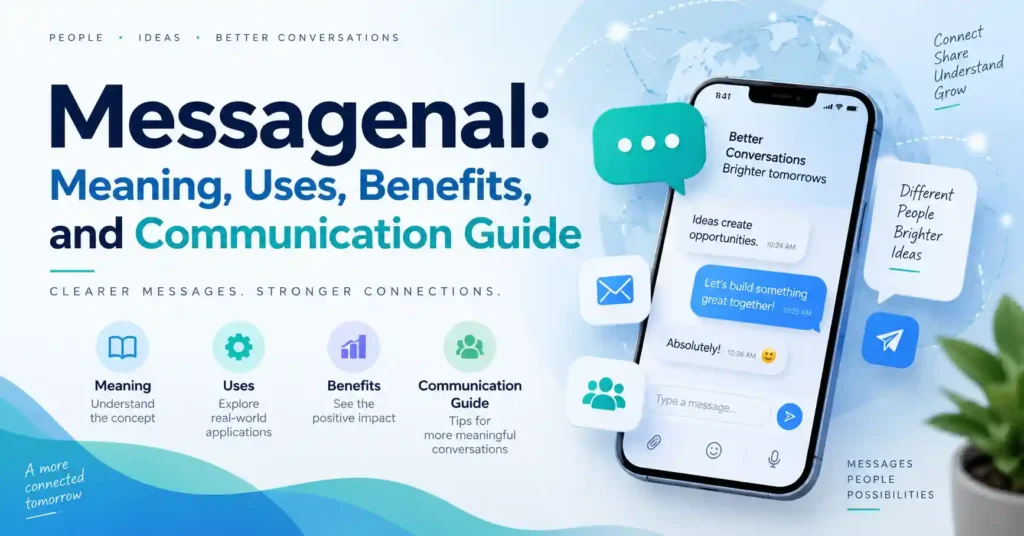
Messagenal is best understood, based on the available online evidence, as an emerging term used to describe purposeful and structured digital messaging. Recent explanations commonly connect it with clarity, intention, context, emotional awareness, and useful outcomes. The definitions vary, which is important evidence in itself: there is not yet a single established standard determining exactly what messagenal must mean.
In my analysis, the safest working definition is this: messagenal is an informal communication approach in which a message is designed around a clear purpose, enough context, appropriate tone, and an identifiable next step. That definition captures the recurring idea without pretending that the term has a formally documented academic origin.
The distinction becomes clearer when we compare it with ordinary messaging. Sending a message only proves that words were transmitted. Effective communication requires more. The recipient must understand what the sender means, recognize why the information matters, and know whether any response or action is expected.
Suppose a manager writes:
“Can you update this soon?”
The message is short, but it leaves several questions unanswered. Which document needs updating? What should change? What does “soon” mean? Who approves the result?
A more messagenal-style version could read:
“Please update the pricing table in the September proposal by 3 p.m. today using the figures in the finance sheet. Send the revised version to me for approval before sharing it with the client.”
Nothing technologically advanced happened here. The improvement came from adding purpose, context, ownership, and a next action.
Why the Meaning of Messagenal Needs Careful Explanation
One unusual feature of this keyword is the disagreement between sources. Some recent pages describe Messagenal as a unified communication platform, while other sources explicitly say that a recognized software product under that description cannot be reliably confirmed.
That contradiction should not be hidden from readers.
A responsible explanation must distinguish three possibilities:
| Interpretation | What It Means | Strength of Public Evidence | Practical Position |
|---|---|---|---|
| Communication philosophy | A mindset focused on meaningful, intentional messages | Common across recent articles | Reasonable working interpretation |
| Messaging framework | A repeatable method for improving clarity, context, tone, and action | Commonly described but not formally standardized | Useful as an informal framework |
| Standalone software platform | A specific app combining chat, files, search, calls, or collaboration | Public confirmation is inconsistent | Treat specific feature claims cautiously |
The most important takeaway from this comparison is that messagenal currently makes more sense as a communication concept than as a clearly verified software category or product. Several recent sources have reached a similar conclusion after reviewing the term.
I would therefore avoid statements such as “Messagenal offers encrypted calls,” “Messagenal integrates with business software,” or “Messagenal has these subscription plans” unless an official product source can be verified. Those are product claims, not general communication principles.
Why Messagenal Fits Modern Digital Communication
The popularity of an idea like messagenal is understandable when we look at how much communication modern workers must process. Messages now arrive through email, workplace chat, project-management tools, video-meeting platforms, shared documents, customer-support systems, social networks, and mobile notifications.
Microsoft’s 2023 Work Trend Index described the volume of information and always-on communication as a form of “digital debt.” Its research reported that Microsoft 365 users spent 57 percent of their time communicating and 43 percent creating, while 68 percent of surveyed employees said they lacked enough uninterrupted focus time during the workday.
That research helps explain why sending more messages is not necessarily the answer.
Microsoft summarized the problem particularly well:
“The pace of work is outpacing our ability to keep up.”
Microsoft Work Trend Index
I see that quotation as highly relevant to messagenal because it shifts attention from message quantity to communication quality. If people already have more information than they can comfortably process, improving communication requires reducing unnecessary cognitive work rather than adding another layer of noise.
Academic research also supports the broader concern. A 2024 systematic literature review of digital communication examined 84 publications and noted that digital communication differs from face-to-face interaction in important ways, including reduced non-verbal cues and asynchronous communication.
Those characteristics create practical problems. A facial expression can soften a statement during an in-person conversation. A quick spoken question can resolve uncertainty immediately. In an email or chat message, the recipient may see only the words, without the surrounding tone or immediate opportunity to clarify.
That is where the practical logic behind messagenal becomes useful.
The Core Principles of Messagenal Communication
I would reduce messagenal to six core principles rather than surrounding it with complicated terminology.
Start With a Clear Purpose
Before writing, the sender should know why the message exists.
A message may be intended to:
- inform someone,
- request a decision,
- ask for an action,
- clarify a misunderstanding,
- provide evidence,
- confirm an agreement,
- warn about a risk,
- persuade an audience,
- or maintain a relationship.
When the purpose is unclear to the sender, the message usually becomes unclear to the recipient.
For example, compare:
“Just sharing the updated report.”
with:
“I’m sharing the updated report for your approval. Please review pages 4 and 7 and confirm by Thursday whether we can send it to the client.”
The second message has a purpose that can be understood immediately.
Put the Main Point Early
One of the strongest principles associated with clear communication is to avoid making readers search for the important information.
The National Institutes of Health recommends:
“Put your main message at the beginning of your document.”
National Institutes of Health
This advice translates naturally into messagenal communication.
In an email, the request should not be hidden beneath six paragraphs of background. In workplace chat, the urgent issue should not appear after unrelated greetings and history. In customer communication, the solution or required next step should be easy to identify.
Background still matters, but background should support the main message rather than conceal it.
Give Enough Context
Conciseness is valuable, but extreme brevity can be just as confusing as excessive detail.
Consider:
“Approved.”
Approved what? The budget? The wording? The timeline? The entire project?
A slightly longer response may eliminate uncertainty:
“I approve the revised homepage copy. You can publish this version without further edits.”
That message is still brief, but the context makes it actionable.
In my view, good messagenal communication asks a simple question: What does the recipient need to know so they do not have to guess?
Use Language the Audience Understands
Clear communication depends on the recipient, not merely the sender.
A software engineer may understand API, latency, repository, and deployment without explanation. A customer buying a service may not.
The UK Government’s publishing guidance emphasizes plain English and advises writers not to use formal or long words when shorter everyday alternatives work. It also recommends explaining specialist language when it is genuinely necessary.
The CDC expresses the same principle directly:
“The key to plain language is to write clearly and concisely.”
Centers for Disease Control and Prevention
I believe this is one of the most practical foundations for messagenal. Good communication is not about making the writer sound sophisticated. It is about helping the reader understand accurately and efficiently.
Match Tone to the Situation
Words carry information, but tone affects interpretation.
“Send it today.”
and
“Could you please send the final version today so I can include it in the client review?”
may request the same action, but they create different impressions.
Tone becomes especially important when messages concern:
- criticism,
- delays,
- disagreements,
- payment,
- performance,
- customer complaints,
- sensitive personal matters,
- emergencies,
- or unexpected changes.
Messagenal communication should not mean adding artificial friendliness to every sentence. It means choosing a tone that fits the relationship, seriousness, urgency, and emotional context.
Make the Next Step Obvious
Many messages communicate information but fail to communicate responsibility.
A strong message answers questions such as:
- Who needs to act?
- What needs to happen?
- When should it happen?
- What does completion look like?
- Does the recipient need to reply?
This is where messagenal becomes outcome-oriented rather than merely descriptive.
How Messagenal Can Improve Workplace Communication
Workplace communication is one of the clearest applications because teams constantly exchange requests, decisions, updates, documents, questions, and deadlines.
A messy workplace message often creates a second message.
Then a third.
Then a meeting.
For example:
“Any update on this?”
The recipient may need to ask, “Which part?”
The sender explains.
The recipient asks when it is needed.
The sender provides a deadline.
Four messages were required to communicate what one structured message could have delivered.
A messagenal version might be:
“Could you confirm whether the supplier approved the revised packaging design? I need the status by 2 p.m. so I can finalize tomorrow’s production schedule.”
The practical benefit is not simply that the sentence sounds better. The recipient now knows the subject, information required, deadline, and reason.
Research on email overload makes this especially relevant. A study published in Information & Management examined 1,372 employees and found that email overload during work was associated with increased job stress and reduced job and life satisfaction.
I would not claim that messagenal alone solves email overload. That would go beyond the evidence. However, clearer messages can reduce avoidable back-and-forth communication, which addresses one practical source of digital friction.
Messagenal for Remote and Hybrid Teams
Remote communication removes many of the signals people naturally use in shared physical spaces.
A colleague sitting nearby may notice that someone is busy. A remote colleague sees only an online status indicator.
A manager speaking face-to-face can recognize confusion immediately. In asynchronous text, confusion may remain invisible for hours.
That makes context more valuable.
A remote-team message should often contain:
- the topic,
- the relevant background,
- the current status,
- the required action,
- the owner,
- and the deadline.
For example:
“Client ABC asked us to move Monday’s campaign launch to Wednesday because legal review is still open. Sarah is updating the creative schedule. David, please revise the paid-media start date by 4 p.m. today and confirm here when complete.”
This message creates a small shared record. Someone reading it later can understand what changed, why it changed, who owns the action, and when the action is due.
That is particularly important in asynchronous work, where the recipient may read the message several hours after it was written.
Messagenal in Customer Service
Customer-service communication should reduce effort for the customer.
Imagine a customer reports that an order has not arrived.
A weak response says:
“We apologize for the inconvenience. Our team is looking into this matter and will provide an update shortly.”
The response sounds polite, but it raises questions. Has anyone actually checked the shipment? When will “shortly” be? Does the customer need to do anything?
A stronger version could say:
“I’m sorry your order has not arrived. I checked the tracking record, and the carrier has not updated it since Monday. I have opened a delivery investigation today. You do not need to take any action. We will email you with the result within two business days.”
The second response reduces uncertainty.
Messagenal customer service, as I interpret it, should aim for five things:
- acknowledge the issue,
- state what is known,
- explain what is being done,
- tell the customer what they need to do,
- and specify what happens next.
The goal is not simply friendliness. It is confidence through clarity.
Messagenal in Marketing and Brand Communication
Marketing introduces another challenge: businesses often want to communicate too many benefits at once.
A homepage might claim that a product is innovative, powerful, flexible, affordable, secure, intelligent, scalable, simple, industry-leading, and transformative.
The more claims appear, the less memorable any individual claim becomes.
A messagenal approach would begin with the audience’s central problem.
For example:
Weak positioning:
“Our innovative all-in-one platform provides powerful next-generation solutions for modern teams.”
Clearer positioning:
“Track client approvals, deadlines, and project files in one workspace so your team spends less time searching for updates.”
The second version is more specific. A reader can understand what the product does and why it may matter.
This approach is consistent with plain-language guidance from government and health communication sources, which repeatedly emphasizes audience needs, direct wording, active voice, and early presentation of important information.
Practical Messagenal Examples Before and After
The easiest way to understand the concept is to compare common messages.
Project Update
Before:
“We are still working through some things and there might be a small delay depending on what happens with the supplier.”
After:
“The supplier has delayed the packaging delivery by two days, so our expected launch date is now September 14. I will confirm the final schedule tomorrow after the supplier sends its dispatch notice.”
The improved version identifies the cause, consequence, date, and next update.
Meeting Request
Before:
“Can we have a meeting about marketing?”
After:
“Can we meet for 20 minutes tomorrow to choose between the two October campaign concepts? I’ll send both options beforehand so we can make the final decision during the call.”
The second message explains why the meeting exists and what outcome is expected.
Internal Request
Before:
“Please take a look when you have time.”
After:
“Please review the attached contract and flag any payment or cancellation terms that need legal approval. I need your comments by noon Friday.”
The recipient now knows what “take a look” means.
Customer Update
Before:
“Your request is being processed.”
After:
“We received your refund request today. Our payments team will review it within three business days, and we will email you once the refund is approved or if we need more information.”
The customer receives a timeline and expectation.
A Step-by-Step Method for Writing a Messagenal Message
I find it more useful to turn the concept into a repeatable process than to treat it as an abstract philosophy.
Step 1: Decide What the Message Must Achieve
Write the objective in your own mind before composing the message.
For example:
“I need approval.”
“I need the customer to upload a document.”
“I need to explain why the deadline changed.”
“I need the team to choose one option.”
If you cannot describe the purpose in one sentence, the message may contain too many competing goals.
Step 2: Identify What the Reader Already Knows
Do not repeat an entire history if the reader has followed the conversation.
At the same time, do not assume knowledge they do not have.
The correct level of context depends on:
- the relationship,
- previous messages,
- complexity,
- urgency,
- and consequences of misunderstanding.
Step 3: Put the Essential Information First
Ask what the recipient needs to see immediately.
For an urgent request, that may be the deadline.
For a project update, it may be what changed.
For customer support, it may be the resolution.
For an executive summary, it may be the decision required.
Step 4: Remove Unnecessary Language
Look for phrases that do not add meaning.
Instead of:
“At this particular point in time, we are currently in the process of reviewing…”
consider:
“We are reviewing…”
Cutting unnecessary words does not make communication cold. It gives important words more space.
Step 5: Check Ambiguous Words
Words such as these often cause problems:
- soon,
- later,
- quick,
- urgent,
- this,
- that,
- some,
- maybe,
- possibly,
- final,
- complete.
Sometimes they are appropriate. Sometimes they hide information.
“Please send it soon” could become “Please send it by 11 a.m. Wednesday.”
Step 6: Add the Next Action
If the recipient must do something, say so directly.
If no action is needed, that can also be stated:
“No action is required. I’m sharing this for your records.”
That sentence can prevent unnecessary replies.
Step 7: Read the Message From the Recipient’s Position
Before sending, ask:
“Would I know exactly what this means if I had not written it?”
This simple test exposes missing context surprisingly well.
Messagenal Message Checklist
The following table turns the framework into a practical editing tool.
| Element | Question to Ask | Weak Example | Stronger Messagenal Version |
|---|---|---|---|
| Purpose | Why am I sending this? | “Just checking in.” | “Can you confirm whether the invoice was approved?” |
| Context | Does the reader know what I mean? | “The issue is fixed.” | “The checkout payment error reported this morning is fixed.” |
| Action | What should happen next? | “Thoughts?” | “Please choose option A or B by Friday.” |
| Deadline | When is action required? | “ASAP.” | “Please reply by 2 p.m. today.” |
| Ownership | Who is responsible? | “Someone should update it.” | “Maya, please update the pricing sheet.” |
| Tone | Does the wording fit the situation? | “You missed this again.” | “The attachment was missing. Could you resend it?” |
| Brevity | Is anything unnecessary? | Long background before the request | Request first, essential context second |
| Accuracy | Could a detail be misunderstood? | “Next Monday” in an international team | “Monday, September 14” |
The central lesson from this checklist is that messagenal communication is not simply short communication. A ten-word message can be poor if it forces the reader to ask three questions. A sixty-word message can be efficient if it supplies everything needed for action.
Common Messagenal Mistakes and Misconceptions
Because the term is still loosely defined, several misconceptions can easily develop around it.
Mistake 1: Treating Messagenal as a Proven Software Platform
Some pages describe Messagenal as though it were an established collaboration application with features such as chat, file sharing, calls, search, or integrations. Other investigations have found no consistent official product presence supporting those descriptions.
I would not repeat software specifications without an official source.
Mistake 2: Believing Every Message Must Be Short
Clarity is not measured by word count.
“Meeting moved. Tell everyone.”
is shorter than:
“Tomorrow’s finance meeting has moved from 10 a.m. to 1 p.m. because the quarterly figures will not be ready in the morning. Please update the calendar invitation and notify the external accountant.”
The second message is longer and more useful.
Mistake 3: Removing Human Tone
Efficient communication should not become robotic.
A message about bereavement, illness, criticism, disappointment, or a customer complaint may require empathy before instruction.
Messagenal should improve human understanding, not remove humanity.
Mistake 4: Including Every Possible Detail
Context helps only when it is relevant.
Excessive detail can bury the important point. The NIH advises communicators to include details readers need while recognizing that too many details can dilute the main message.
Mistake 5: Assuming Sending Equals Communicating
The sender may believe a message is clear simply because it makes sense to them.
The real test is whether the recipient can correctly interpret it.
That is why audience awareness belongs at the center of the framework.
Expert Recommendations for Applying Messagenal
Although messagenal itself is not an established academic communication theory, I believe its useful elements become stronger when connected to recognized communication guidance.
Use Plain Language Without Oversimplifying Meaning
Plain language is not childish language.
GOV.UK notes that even specialist readers generally prefer clear English because it helps them understand information quickly.
Use technical vocabulary when it is necessary and appropriate, but explain terms that the audience may not know.
Prefer Active Voice When Responsibility Matters
Compare:
“The document should be reviewed by Friday.”
with:
“Daniel will review the document by Friday.”
The second version identifies responsibility.
Both CDC and GOV.UK communication guidance recommend active voice because it tends to be more direct.
Separate Information From Action
A useful structure for many workplace messages is:
What happened → What it means → What happens next → Who acts
For example:
“The shipment has been delayed at customs. Delivery is now expected Tuesday instead of Friday. I have informed the customer. Rachel, please update the project schedule before noon.”
This structure reduces interpretation work.
Choose the Right Channel
Not every issue belongs in chat.
Use a synchronous conversation when:
- emotions are high,
- the issue is complex,
- rapid back-and-forth discussion is required,
- misunderstanding could cause serious consequences,
- or several decisions depend on one another.
Use asynchronous writing when:
- recipients work in different time zones,
- the information needs a record,
- immediate response is unnecessary,
- details should be reviewed carefully,
- or the recipient needs time to think.
The research literature recognizes asynchrony as one of the distinctive characteristics separating digital communication from face-to-face communication.
Treat Attention as a Limited Resource
Every unnecessary notification competes with work, thought, and other communication.
The practical goal should therefore be fewer meaningless interruptions, not simply faster messaging.
Before sending another “Any update?” message, consider whether the original request clearly specified what update was needed and when.
Is Messagenal.com the Same as the Communication Concept?
Readers searching the keyword may also encounter messagenal.com, which creates an important distinction.
The existence of a domain with the same word does not establish that the domain created, owns, or officially represents the communication concept described in recent articles.
Public domain-information services indicate that messagenal.com was registered in December 2024. Third-party reputation services have raised concerns about the site’s trust profile, although automated reputation ratings are not definitive proof of fraud.
One service describes the domain as an online retail operation rather than a digital communication platform, which further illustrates why the term and the domain should not automatically be treated as the same thing.
My practical advice is straightforward: if someone encounters a website using the messagenal name, evaluate that website independently. Check business identity, contact information, payment protections, reputation history, privacy practices, and independent reviews before providing sensitive information or making a purchase.
The communication concept discussed in this article does not require using any particular website.
Benefits and Limitations of Messagenal
A balanced view should recognize both sides.
Potential benefits include:
- clearer expectations,
- less unnecessary back-and-forth,
- easier asynchronous collaboration,
- better documentation of decisions,
- fewer ambiguous requests,
- improved customer understanding,
- more useful project updates,
- and greater attention to audience needs.
However, there are limitations.
First, messagenal is not a standardized methodology. Two writers may use the word differently.
Second, communication problems are not always writing problems. Poor processes, unclear authority, missing information, unrealistic deadlines, organizational politics, or inadequate tools cannot be fixed simply by rewriting a message.
Third, communication sometimes needs conversation rather than optimization. Relationships involve emotion, negotiation, trust, and interpretation.
Finally, clarity cannot guarantee agreement. Someone may understand a message perfectly and still disagree with it.
I think that distinction is essential. Effective communication aims to reduce avoidable misunderstanding. It does not eliminate legitimate differences of opinion.
How to Decide Whether a Message Is Truly Messagenal
A practical test can be completed in less than a minute.
Ask five questions:
- Purpose: Can the reader tell why this message exists?
- Context: Does the reader have enough information to understand it?
- Clarity: Is the main point easy to find?
- Action: Is the next step clear?
- Tone: Does the wording fit the audience and situation?
If all five answers are yes, the message is likely accomplishing what the messagenal concept is supposed to represent.
If several answers are no, rewriting will probably help.
The strongest messages often feel simple after editing, but that simplicity is the result of deliberate choices.
Conclusion
I believe the most responsible way to understand messagenal is as an emerging label for intentional digital communication rather than a firmly established technology, scientific theory, or universally recognized platform. The term’s online definitions remain inconsistent, but the practical ideas repeatedly associated with it are useful: know the purpose of a message, lead with the important point, provide enough context, use language the audience understands, choose an appropriate tone, and make the next action clear.
What matters to me is not whether messagenal eventually becomes a widely accepted term. The more important lesson is that digital communication improves when we stop measuring success by how quickly or frequently we send messages and start considering how accurately those messages are understood.
The next time you write an email, customer reply, project update, or team chat, read it once from the recipient’s perspective. Ask what they know, what they might misunderstand, and what they need to do next. That small habit captures the most practical value of messagenal and can make everyday communication noticeably more useful.
Read More: Coomersu: Meaning, Community Commerce & How It Works
Frequently Asked Questions
What Does Messagenal Mean?
Messagenal is an emerging term commonly used online to describe intentional, clear, context-aware digital communication. I would treat it as an informal framework rather than a formally established communication theory because current sources do not provide one universally accepted definition or authoritative origin. The practical idea is to design messages so recipients can understand the purpose, relevant context, tone, and expected action without unnecessary confusion. Recent articles consistently connect messagenal with clarity and purposeful messaging, although individual explanations vary.
Is Messagenal a Real Messaging App?
There is not enough consistent public evidence to confidently describe Messagenal as an established mainstream messaging application with a verified set of features. Some websites call it a unified communication platform, while other sources explicitly note the absence of clear official product confirmation. I therefore recommend treating claims about specific Messagenal software features cautiously unless they can be traced to an official developer, verified app-store listing, or clearly identified company.
How Does Messagenal Improve Communication?
Messagenal can improve communication by encouraging the sender to make the purpose, context, and required action easier to understand. For example, instead of writing “Please fix this soon,” a sender might specify which problem needs fixing, who owns it, and the deadline. These principles align with established plain-language guidance from organizations such as the CDC, NIH, and GOV.UK, which emphasize direct wording, audience awareness, active voice, and putting important information early.
Can Messagenal Be Used in Business Communication?
Yes. The practical ideas associated with messagenal can be applied to workplace email, team chat, project updates, meeting requests, customer service, marketing, and remote collaboration. A business message becomes more useful when recipients know what changed, why it matters, who needs to act, and when the action is required. This is especially relevant in environments where employees already manage large volumes of email, chats, meetings, and notifications. Microsoft research has documented the substantial amount of work time spent on communication.
What Are the Main Principles of Messagenal?
The main principles I recommend are purpose, clarity, context, audience awareness, appropriate tone, and a clear next step. A good message should answer why it was sent, what the recipient needs to understand, and whether action is expected. The message does not need to be extremely short. It needs to contain the right amount of information. A short but ambiguous message can create more work than a slightly longer message that answers the recipient’s likely questions.
Is Messagenal the Same as Plain Language?
No. Plain language is a well-established approach to making information understandable and direct, while messagenal is a newer and less formally defined term. However, the two overlap considerably. Plain-language guidance supports several principles that fit the messagenal concept, including shorter sentences, familiar vocabulary, active voice, audience awareness, and placing important information early. Messagenal can be viewed as applying similar clarity principles specifically to purposeful digital messages and interactions.
Is Messagenal.com Safe?
Messagenal.com should be evaluated separately from the communication concept. Third-party reputation services have raised concerns about the domain, including limited reputation information and hidden ownership details, although automated trust scores should not be treated as definitive proof that a website is fraudulent. Before purchasing, registering, or providing personal information on an unfamiliar site, check independent reviews, company identity, refund terms, payment protections, and contact information.
Why Is Messagenal Becoming a Search Topic?
The term has appeared across a growing cluster of online articles during 2026, often connected with intentional messaging, communication overload, and digital productivity. However, the sudden growth of content does not prove that the concept has a long-established academic or commercial history. Some commentators have specifically questioned whether the term originated as a low-competition web keyword rather than an established communication discipline. For that reason, readers should distinguish useful communication principles from unsupported claims about the history or authority of the word itself.
Sources and References
- Microsoft Work Trend Index, “Will AI Fix Work?” May 9, 2023.
- Microsoft, 2023 Annual Work Trend Index announcement and research findings.
- Strauss, Christina, Michael Dominic Harr, and Torsten M. Pieper, “Analyzing Digital Communication: A Comprehensive Literature Review,” Management Review Quarterly, published July 27, 2024.
- Martin, Ludivine, Chantal Fuhrer, and Nicolas Poussing, “E-mail Overload,” Information & Management, 2025.
- Centers for Disease Control and Prevention, “Get to the Point: Write for Immediate Understanding.”
- National Institutes of Health, “Before You Start Writing” and “Presenting Your Information.”
- GOV.UK Publishing Guidance, “Use Clear Language.”
- Recent Messagenal explainers and investigations used to assess how the emerging term is currently being defined online.
- Public domain and third-party reputation information relating to messagenal.com.
Disclaimer
This article is an informational analysis of the term messagenal based on publicly available material reviewed in September 2026. Messagenal does not currently appear to have a single authoritative definition, and descriptions of it as a specific software platform remain inconsistent across available sources. References to communication practices are educational and should not be interpreted as proof of an official Messagenal methodology, certification, company, or product. Website reputation services and automated trust scores can produce false positives or incomplete assessments, so readers should independently verify any website, company, application, payment request, or service before sharing personal information or making financial decisions.