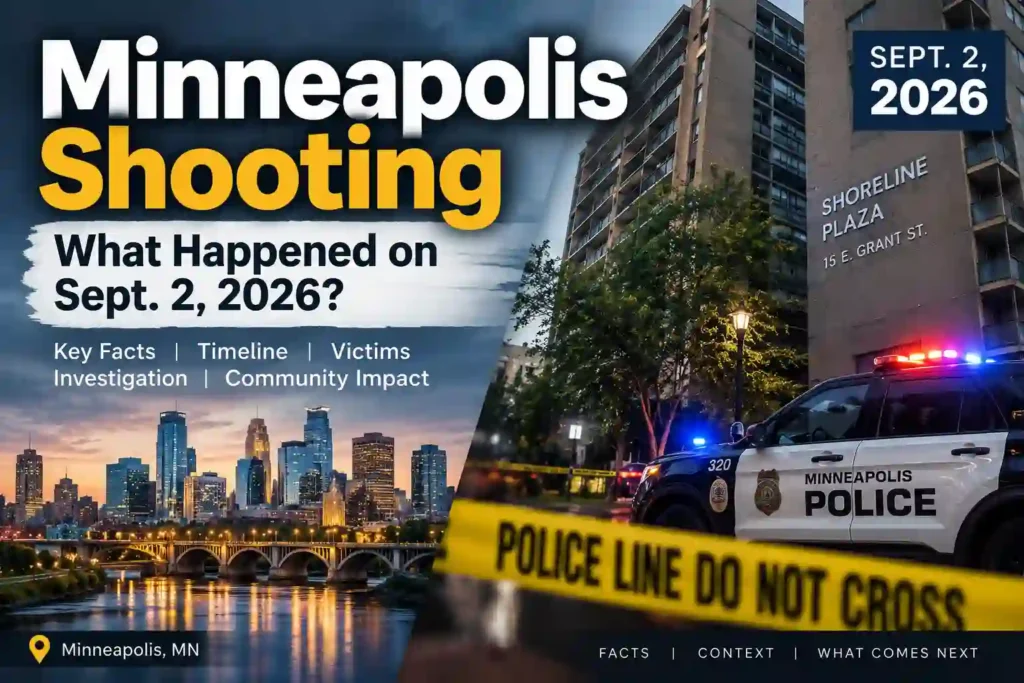
Minneapolis Shooting: What Happened on Sept. 2, 2026
I have approached the Minneapolis Shooting of September 2, 2026 as a developing public-safety story where accuracy matters more than speed or dramatic language. The attack at Shoreline Plaza, a high-rise apartment building at 15 E. Grant Street near Loring Park in downtown Minneapolis, left two residents dead and several people wounded. The suspected shooter, 35-year-old Carlton Neal Johnson II, was also killed after exchanging gunfire with Minneapolis police. More than two weeks later, newly released body-worn camera footage, 911 transcripts, court records, and investigative reporting have provided a much clearer picture of what happened. (Minneapolis)
The latest reporting indicates that five people other than the two residents who died were wounded by gunfire: a woman believed to be the mother of Johnson’s child, two apartment employees, and two Minneapolis police officers. Early reports also counted a third officer as injured, although that officer was not shot. Additional officers experienced effects from an airborne substance or were injured in a vehicle crash while responding. Those distinctions help explain why early reports described different totals for the number of injured people. (AP News)
In my analysis, the story is about more than the minutes in which gunfire occurred. Public records and subsequent reporting describe earlier threats, an eviction proceeding, a restraining-order request by a neighbor, prior police contact, and a threat reportedly sent to apartment staff shortly before the shooting. Those facts have raised questions about how separate warning signs are assessed when no single intervention has yet removed a firearm or prevented contact between the people involved. At the same time, it would be inaccurate to claim that the public record already proves a particular agency or official could legally have prevented the shooting. That question remains more complicated than hindsight can make it appear. (MPR News)
Key Facts About the Minneapolis Shooting
The incident occurred on Wednesday, September 2, 2026, at Shoreline Plaza, formerly known as Loring Towers, near Loring Park and the Minneapolis Convention Center. Minneapolis police initially responded at approximately 4:36 p.m. after reports of a shooting. Officers arriving at the building found victims and continued hearing gunfire from inside. (Minneapolis)
State investigators later identified the two residents who were killed as Dale Henry Spry, 63, and Muse A. Afrah, 61. Both lived in the apartment building. Authorities identified Carlton Neal Johnson II, 35, as the shooter. The Minnesota Bureau of Criminal Apprehension said Johnson was killed during an exchange of gunfire with Minneapolis officers on the ninth floor. (MPR News)
Investigators say the violence began outside the building during what had been arranged as a child custody exchange. Johnson allegedly shot the mother of his child in the leg. The child escaped with people nearby and was not physically injured. Johnson then entered the building, shot two apartment employees on the first floor, took an elevator to the ninth floor and fatally shot the two residents. (MPR News)
Police followed the sound of gunfire upward. Officers Joseph Michnowski and Yahye Ahmed were shot during the response. Video released by Minneapolis on September 16 shows officers moving through the building and coming under fire on the ninth floor. The city has published body-camera footage from several officers as part of its public critical-incident records. (CBS News)
How the Minneapolis Shooting Unfolded
The Incident Began During a Custody Exchange
According to the Minnesota Bureau of Criminal Apprehension, the chain of events began outside Shoreline Plaza during an arranged custody exchange involving Johnson and the mother of one of his children. Authorities said Johnson shot the woman in the leg. The child was able to get away and was not physically harmed. (MPR News)
This detail matters because investigators have characterized domestic violence as central to the event rather than treating the first shooting as an unrelated confrontation preceding an indiscriminate attack.
BCA Superintendent Drew Evans summarized that context this way:
“This is once again a situation where domestic violence is central to a really terrible situation.”
Drew Evans, Minnesota Bureau of Criminal Apprehension (The Washington Post)
I think the distinction is important for understanding the sequence. The shooting developed from an interpersonal conflict into a mass-casualty incident affecting apartment workers, residents, police officers, and people who had no apparent involvement in the original dispute.
Gunfire Continued Inside Shoreline Plaza
Authorities say Johnson returned to the apartment building after shooting the woman outside. On the first floor, he shot two employees. One was initially described by investigators as being critically injured. Johnson then used an elevator to reach the ninth floor, where he lived. (MPR News)
On that floor, Johnson shot and killed Spry and Afrah. Investigators initially said they had not established whether those residents had been specifically targeted or encountered during the attack. I would therefore avoid assigning a motive for their killings unless investigators release stronger evidence establishing one. (The Washington Post)
Police entered the high-rise and followed the sound of gunfire toward the upper floors. Early city updates described a haze on the upper level that substantially reduced visibility. Later video reporting indicated that smoke or airborne material could be seen during the police response. (Minneapolis)
Officers Encountered the Shooter on the Ninth Floor
The body-camera footage released on September 16 provides the clearest public view so far of the police response inside the building. Video shows officers climbing toward the ninth floor and searching the hallway before gunfire erupts at close range. (CBS News)
Officer Joseph Michnowski was shot twice in the abdomen, while Officer Yahye Ahmed was shot in the leg. CBS Minnesota reported on September 16 that Michnowski had returned home from the hospital. (CBS News)
One brief statement recorded on the body-camera footage captures how rapidly officers had to communicate what had happened:
“Shooter’s on the ninth floor. I took some rounds.”
Officer Joseph Michnowski, Minneapolis Police Department body-camera footage (CBS News)
The footage does not by itself answer every question about the confrontation. The Minnesota Bureau of Criminal Apprehension is responsible for investigating the officers’ use of force, while the city’s critical-incident page now provides public access to body-camera recordings and related records. (CBS News)
Timeline of the Minneapolis Shooting
The following timeline combines the sequence described by investigators with later reporting. Some exact minute-by-minute details may be refined as additional records are released.
| Stage | What Authorities and Records Say |
|---|---|
| Before Sept. 2 | Johnson had been involved in an ongoing eviction proceeding and had previously been accused of threatening behavior involving a firearm. (MPR News) |
| Night before attack | Apartment staff reportedly received an email in which Johnson threatened to shoot staff members. (Star Tribune) |
| Sept. 2, before shooting | A building employee reportedly contacted police concerning the threat. (Star Tribune) |
| Around 4:30 p.m. | Investigators say Johnson met the mother of his child for a custody exchange and shot her in the leg. (MPR News) |
| Moments later | Johnson entered Shoreline Plaza and shot two employees on the first floor. (MPR News) |
| Ninth floor | Johnson went upstairs and fatally shot residents Dale Henry Spry and Muse A. Afrah. (MPR News) |
| Around 4:36 p.m. | Minneapolis police were dispatched following emergency reports. (MPR News) |
| Police entry | Officers entered the high-rise, found victims and followed continuing gunfire upward. (Minneapolis) |
| Ninth-floor confrontation | Two officers were shot. Police exchanged gunfire with Johnson, who was killed. (MPR News) |
| Sept. 3 | Investigators publicly identified Johnson, Spry and Afrah and described the custody-exchange sequence. (MPR News) |
| Sept. 16 | Minneapolis released body-camera footage and other public critical-incident material. (Minneapolis) |
What stands out to me is how quickly an act that began outside the building expanded across multiple floors. It also explains why initial news reports contained changing casualty counts and incomplete descriptions. Authorities were simultaneously treating shooting victims, searching a large building, dealing with injured officers, evacuating residents and beginning a major investigation.
Who Was Killed and Injured
Two apartment residents, Dale Henry Spry and Muse A. Afrah, were killed. The Hennepin County Medical Examiner’s Office identified them following the shooting, according to state investigators and local reporting. (MPR News)
Five other people were wounded by gunfire according to the most recent Associated Press account: the woman shot during the custody exchange, two employees of the apartment complex and Officers Michnowski and Ahmed. (AP News)
Early reports frequently described six injured people because a third Minneapolis officer was also injured during the incident but was not reported as having been shot. The City of Minneapolis additionally reported that four officers experienced adverse effects after encountering an unknown airborne substance, while two officers were injured when a squad car crashed during the emergency response. These categories should not be added together casually because some reports may refer to different types of injuries or overlapping responders. (Minneapolis)
Johnson also died during the confrontation. State officials later reported that he suffered multiple gunshot wounds and classified his death as a homicide, meaning death caused by another person. The BCA said Minneapolis police exchanged gunfire with him before he died. (Forth News)
In writing about casualty figures, I believe it is important to distinguish between people killed by the shooter, the shooter himself, people wounded by gunfire and first responders injured through other mechanisms. Without that distinction, headlines saying “three dead” can leave readers assuming three victims were killed by the gunman when the total includes Johnson.
What the Newly Released Body-Camera Footage Shows
Minneapolis published body-worn camera footage from Officers Michnowski, Liban Mohamed Ibrahim, Callahan and Ahmed on its September 2 critical-incident page. The city states that the footage was released under Minnesota law governing public access to body-camera data. (Minneapolis)
Reporting on the videos says officers can be seen climbing through Shoreline Plaza, reaching the ninth floor and searching for the gunman. Gunfire then breaks out at close range. Michnowski is hit twice in the abdomen but continues moving, while Ahmed suffers a gunshot wound to the leg. (CBS News)
Later footage shows the final exchange of gunfire in which Johnson was killed, according to CBS Minnesota. A cloud inside the hallway was visible, consistent with earlier official descriptions that officers had encountered limited visibility on an upper floor. (CBS News)
The release adds evidence to the public record, but I would not treat video alone as a complete reconstruction. Body-camera footage records only particular fields of view, and investigators can combine it with ballistics, witness statements, 911 records, medical evidence, building surveillance and other sources.
The BCA’s review of the police shooting remains important because it separates two related questions: what Johnson allegedly did during the attack, and whether the officers’ use of deadly force complied with applicable law and policy. The public evidence strongly documents an active gunfire threat, but the formal use-of-force investigation is still the process responsible for reaching official findings. (CBS News)
How Quickly Police Responded
Reports citing authorities say police reached the building only a few minutes after the first 911 call. AP’s reporting described officers arriving approximately two minutes and 26 seconds after the initial emergency call. (AP News)
The city initially said officers began arriving at about 4:39 p.m. after the call came in around 4:36 p.m. They entered rather than waiting outside because victims were already present and gunfire was continuing. (GovDelivery)
Mayor Jacob Frey emphasized the danger faced by officers and other responders at the scene:
“I can’t emphasize enough how dangerous this situation was and how heroic our officers were in response.”
Minneapolis Mayor Jacob Frey (Minneapolis)
The city said officers helped move victims to safety while continuing to search for the shooter. Multiple agencies assisted, including the Minnesota State Patrol, Hennepin County Sheriff’s Office, Minneapolis Park Police, St. Paul police and other departments. The FBI also assisted at the scene. (Minneapolis)
Warning Signs Reported Before the Shooting
One of the most significant developments after the immediate emergency was the disclosure of earlier allegations involving Johnson.
Court records cited by MPR News show that the apartment property had begun eviction proceedings against Johnson in June. The complaint described alleged incidents involving assault, firearm display, threats against another resident and statements about killing someone. The eviction case remained pending when the September 2 shooting occurred, with a trial scheduled for September 11. (MPR News)
A resident who lived above Johnson had also sought a restraining order after alleging that Johnson physically assaulted him and threatened him with a handgun. The resident wrote in the court request that he feared entering and leaving his apartment. (MPR News)
AP reported that Johnson had attracted attention for threatening behavior and that a previous June police investigation involving a firearm did not lead to charges. Hennepin County officials said evidence from that encounter was insufficient to prove a criminal charge beyond a reasonable doubt. (AP News)
That distinction is worth keeping clear. A decision not to prosecute a specific encounter does not necessarily mean authorities determined that no concerning behavior occurred. Criminal prosecution requires evidence sufficient to establish a defined offense under the applicable burden of proof.
A Threat Reportedly Arrived the Night Before
Later reporting added another significant event. The Minnesota Star Tribune reported that Johnson sent an email to apartment staff the night before the attack threatening to shoot employees. A building employee contacted police on September 2 and made a report, according to records and reporting cited by the newspaper. (Star Tribune)
This information raises an understandable question about whether that report could have triggered a different response. The public information available so far does not establish all of the circumstances known to each official at the time, however.
In my view, responsible analysis has to separate a disturbing warning sign from a proven legal conclusion. We now know the later outcome, but officials assessing an earlier threat did not possess hindsight. Evaluating what options were legally available requires knowing the evidence they had, the credibility and immediacy of the threat, what was documented, which officials reviewed it and what legal standards applied.
The Domestic Violence Context
The BCA has explicitly described domestic violence as central to the Minneapolis Shooting because investigators say it began when Johnson shot the mother of his child during a custody exchange. (MPR News)
That framing changes how I understand the incident. It was not simply a random attack appearing without an interpersonal context. Investigators have linked its beginning to a relationship and custody situation before the violence expanded to employees, neighbors and police.
This does not mean every victim had the same connection to the shooter or that investigators have established a single motive for every shooting inside the building. In fact, reporting indicates authorities had not determined whether the two residents killed on the ninth floor were specifically targeted or encountered during the attack. (The Washington Post)
The distinction prevents us from collapsing a complicated sequence into an overly simple narrative. Domestic violence can explain the beginning of an incident without automatically establishing why every later victim was attacked.
Minnesota’s Extreme Risk Protection Order Law
Questions about whether firearms could have been removed before September 2 have focused partly on Minnesota’s Extreme Risk Protection Order law, commonly called an ERPO or “red flag” law.
Minnesota’s ERPO system has been available since January 1, 2024. Under state law, a petition can seek an order preventing a person from purchasing or possessing firearms when the petitioner alleges that the person poses a significant danger of bodily harm to others or a significant risk of suicide through firearm possession. (Minnesota Courts)
The law permits petitions from specified people and officials, including a chief law-enforcement officer or designee, a city or county attorney, certain family or household members and a guardian. A petition must provide specific facts supporting the allegation of significant danger. (MN Revisor’s Office)
Minnesota law also provides for emergency ERPOs. A judge may issue an emergency order when probable cause supports findings that the respondent poses a significant danger involving a firearm and presents an immediate and present danger of bodily harm to others or suicide. The emergency order generally lasts 14 days unless a related hearing occurs sooner. (MN Revisor’s Office)
If an ERPO is issued, Minnesota law directs the respondent to transfer firearms according to statutory procedures. (MN Revisor’s Office)
What the Public Record Does Not Establish
AP reported that no emergency firearm-removal process was initiated against Johnson before the attack. (AP News)
That fact does not by itself tell us whether a petition would have been granted had someone filed one, whether all statutory requirements were satisfied at a particular earlier moment, or whether officials had sufficient evidence in usable form.
There are therefore at least two separate questions. One is whether Minnesota law provided a potential legal mechanism for temporary firearm restrictions. The answer is yes. The second is whether the facts available to an authorized petitioner before September 2 would have satisfied the legal standards and resulted in an order. The public record has not conclusively resolved that second question.
Because ERPO laws are politically debated, I would avoid converting this tragedy into an unsupported conclusion either for or against the policy. The factual point is narrower: Minnesota had an ERPO process, reports describe prior warning signs, no ERPO was reportedly obtained against Johnson and investigators and journalists are examining how those facts intersect. (Minnesota Courts)
Confirmed Facts and Questions Still Being Investigated
Developing news often becomes confusing because confirmed details and reasonable questions appear next to each other. I find the following distinction useful.
| Issue | Current Status |
|---|---|
| Identity of alleged shooter | Carlton Neal Johnson II, 35, identified by authorities. (MPR News) |
| Residents killed | Dale Henry Spry, 63, and Muse A. Afrah, 61. (MPR News) |
| Beginning of attack | Investigators say it began during a custody exchange when Johnson shot the mother of his child. (MPR News) |
| Child’s condition | Authorities said the child was not physically injured. (The Washington Post) |
| Apartment employees | Two were shot and survived. (AP News) |
| Officers shot | Joseph Michnowski and Yahye Ahmed were wounded by gunfire. (CBS News) |
| Shooter’s death | Johnson was killed during an exchange of gunfire with Minneapolis police. (MPR News) |
| Body-camera footage | Released publicly by Minneapolis on Sept. 16. (Minneapolis) |
| Prior eviction case | Pending at the time of the shooting. (MPR News) |
| Earlier firearm-related allegations | Documented in court records and news reporting. (MPR News) |
| Whether every fatal victim was deliberately targeted | Not established publicly. Investigators indicated uncertainty about the two ninth-floor residents. (The Washington Post) |
| Complete analysis of officers’ use of force | BCA investigation remains relevant and ongoing. (CBS News) |
| Whether an ERPO would have been granted earlier | Not established by the available public record. |
The most important lesson from this table is that the major sequence is now relatively well documented, but some of the questions attracting the strongest public debate require conclusions that investigators have not yet established.
Why Early Reports Gave Different Numbers
Anyone following the Minneapolis Shooting in real time may have seen reports referring to five wounded, six injured, three officers injured or seven people struck by gunfire. Those differences are not necessarily evidence that sources were unreliable.
The city initially reported three injured Minneapolis officers, two of whom had been shot. It also reported three other civilians who had been shot, in addition to two civilians who died. Later accounts clarified the sequence and categorized the casualties differently. (Minneapolis)
The most recent AP reporting describes two residents killed and five other people wounded by the shooter: the woman outside the building, two employees and two police officers. (AP News)
A third officer suffered another type of injury during the response. Other responders experienced exposure-related symptoms or injuries connected with the emergency response. Consequently, “people shot,” “people injured” and “officers injured” are not interchangeable categories.
This is a useful example of why I avoid freezing the first casualty count from a breaking-news story into a permanent article. Emergency officials frequently release preliminary totals before they know whether every hospital patient, officer or responder belongs in a particular category.
Community Response After the Shooting
On the evening of the attack, the city established a reunification location at Central Lutheran Church for people affected by the evacuation and disruption at Shoreline Plaza. The American Red Cross also prepared shelter assistance, while the Salvation Army provided food. (Minneapolis)
In the following days, fundraising campaigns were created for victims and their families, according to MPR News. Residents were left dealing not only with physical injuries but also displacement, fear and the psychological impact of violence occurring inside their home. (MPR News)
That impact can be easy to overlook once attention turns toward legal questions about the shooter. A high-rise apartment building is a residential community. People who were not physically shot still experienced lockdowns, gunfire, evacuation, emergency entry by police and the deaths or injuries of neighbors and employees.
I believe responsible coverage should keep those residents in view rather than making the perpetrator the center of every paragraph.
How to Follow Future Minneapolis Shooting Updates Carefully
The City of Minneapolis has established a critical-incident page containing body-camera footage and links to police, fire and 911 records connected with the September 2 event. The page was updated on September 16. (Minneapolis)
For major factual developments, I would prioritize official investigative records together with reporting from organizations that clearly distinguish confirmed information from witness accounts or allegations.
Court documents can be especially useful for understanding events preceding a shooting, but allegations in an eviction complaint, restraining-order request or police report should remain identified as allegations unless a court or investigative finding establishes them.
The same principle applies to motive. Investigators have connected the beginning of the shooting to domestic violence, but that does not give outside observers license to invent psychological explanations for Johnson’s behavior. No responsible analysis requires speculation about his mental state, personality or diagnosis.
Common Misconceptions About the Minneapolis Shooting
One misconception is that three civilian victims were killed by the shooter. Two residents were killed. The third death included in the overall fatality count was Johnson himself. (Minneapolis)
Another misconception is that all three initially reported injured officers were shot. Two officers were wounded by gunfire. A third officer was injured through another mechanism. (MPR News)
It is also inaccurate to describe the attack simply as an unexplained random shooting. Investigators say it began during a custody exchange and have explicitly identified domestic violence as central to the incident. That does not establish that every later victim was targeted for the same reason. (MPR News)
A fourth misconception would be saying that Johnson had no previous contact with authorities. Reporting and court records describe previous allegations and a June firearm-related police investigation. The fact that those earlier events had not resulted in a legal prohibition on possessing his firearm is different from saying authorities had never encountered him. (AP News)
Finally, it would be premature to claim that a particular government intervention definitely would have prevented the shooting. Available reporting identifies missed or unresolved opportunities that warrant scrutiny, but prevention is a counterfactual question. Evidence can show what mechanisms existed and what actions were or were not taken; it cannot prove with certainty how Johnson would have responded to a hypothetical intervention.
What This Case Shows About Developing News
The Minneapolis Shooting demonstrates why major breaking stories change considerably after the first few hours.
On September 2, officials knew that several people had been shot and officers had entered a dangerous high-rise environment. They did not yet publicly have the complete sequence, identified victims, detailed background of the shooter, body-camera evidence or the broader paper trail involving eviction and threats.
By September 3, the BCA had publicly described the custody exchange and identified Johnson and the two people killed. Over the following days, journalists examined court files, interviews and earlier police contacts. On September 16, Minneapolis released body-camera footage and critical-incident records. (MPR News)
As of September 17, AP has reported additional details from the newly available footage and 911 transcripts. Those records have sharpened the timeline and provided additional evidence about what residents and officers experienced. (AP News)
From my perspective, that progression is exactly why a responsible article should mark dates and distinguish initial reports from later findings. “Latest” information can replace an earlier interpretation without making the earlier report dishonest. Sometimes investigators simply know more after records, interviews and forensic evidence become available.
Conclusion
The Minneapolis Shooting on September 2, 2026 began during a child custody exchange outside Shoreline Plaza and developed into a deadly attack inside the downtown apartment building. Investigators say Carlton Neal Johnson II shot the mother of his child, wounded two apartment employees, killed residents Dale Henry Spry and Muse A. Afrah, and wounded two Minneapolis police officers before being killed during an exchange of gunfire with police. (MPR News)
What makes the case especially significant is the documented history preceding the attack. Court records and reporting describe threats, firearm-related allegations, an eviction proceeding and earlier law-enforcement contact. Minnesota also had an Extreme Risk Protection Order process in place, although the available record does not establish that a petition would necessarily have been granted in Johnson’s case. (MPR News)
I believe the most responsible way to follow this story is to distinguish confirmed events from unresolved questions. The recently released body-camera footage and 911 records add substantial information, but investigations are still capable of producing new findings. Readers looking for updates should therefore prioritize dated official records and credible reporting while avoiding speculation about motives, legal culpability or hypothetical outcomes that the evidence has not yet established.
Read More: Jowls: Causes, Prevention, and Treatment Options
Frequently Asked Questions
What Happened in the Minneapolis Shooting?
The September 2, 2026 Minneapolis Shooting occurred at Shoreline Plaza near Loring Park. Investigators say Carlton Neal Johnson II first shot the mother of his child during a custody exchange, then entered the apartment building, shot two employees and killed two residents on the ninth floor. Two Minneapolis police officers were also wounded before Johnson was killed during an exchange of gunfire with officers. (MPR News)
Where Did the Minneapolis Shooting Happen?
The shooting took place at Shoreline Plaza, formerly known as Loring Towers, at 15 E. Grant Street in downtown Minneapolis near Loring Park and the Minneapolis Convention Center. Police initially responded at approximately 4:36 p.m. after receiving reports of gunfire. (Minneapolis)
How Many People Died in the Minneapolis Shooting?
Three people died in the overall incident, but two were civilian victims killed during the attack. They were 63-year-old Dale Henry Spry and 61-year-old Muse A. Afrah. The third person who died was the suspected shooter, Carlton Neal Johnson II, who authorities say was killed during an exchange of gunfire with Minneapolis police. (MPR News)
How Many People Were Wounded?
The latest AP reporting describes five people wounded by the shooter in addition to the two residents who were killed. Those wounded included a woman involved in the custody exchange, two apartment workers and two police officers. Early official reports also described a third officer as injured through another mechanism, which explains some differences between early casualty counts. (AP News)
Who Were the Police Officers Shot in Minneapolis?
The two Minneapolis police officers wounded by gunfire were Joseph Michnowski and Yahye Ahmed. Michnowski was shot twice in the abdomen, while Ahmed was shot in the leg. CBS Minnesota reported on September 16 that Michnowski had returned home from the hospital. (CBS News)
Has Minneapolis Released Body-Camera Video?
Yes. Minneapolis has released body-worn camera footage connected with the September 2 critical incident. The city’s public records page provides footage from multiple officers along with links to police, fire and 911 materials. The page was updated on September 16, 2026. (Minneapolis)
Was the Minneapolis Shooter Facing Eviction?
Yes. Court records reported by MPR News show that Shoreline Plaza’s management had filed an eviction complaint against Johnson in June. The complaint described alleged violent and threatening behavior, including incidents involving a firearm. The eviction case remained pending when the September 2 attack occurred. (MPR News)
Had Police Previously Investigated Carlton Johnson?
Yes. Reporting indicates Minneapolis police had previously investigated a June incident involving Johnson and a firearm. Hennepin County officials said prosecutors did not pursue charges because the available evidence was insufficient to prove a criminal charge beyond a reasonable doubt. (The Washington Post)
Was Domestic Violence Involved in the Minneapolis Shooting?
Yes, according to the Minnesota Bureau of Criminal Apprehension. Investigators say the attack began during a custody exchange when Johnson shot the mother of his child. BCA Superintendent Drew Evans subsequently described domestic violence as central to the incident. (MPR News)
Did Minnesota Have a Red Flag Law Before the Shooting?
Yes. Minnesota’s Extreme Risk Protection Order law has operated since January 1, 2024. Authorized petitioners can ask a court to temporarily prevent someone from purchasing or possessing firearms when statutory danger requirements are met. Reporting indicates no such emergency firearm-removal order was obtained against Johnson before the shooting. The available public evidence does not establish whether a court would have granted one if a petition had been filed. (Minnesota Courts)
Is the Minneapolis Shooting Investigation Finished?
Not all aspects should be treated as fully resolved. The broad sequence of the attack is well documented, and Minneapolis has now released body-camera footage and other records. The BCA has also been investigating the officers’ use of force. Additional investigative findings, records or official conclusions may still emerge. (Minneapolis)
Sources and References
- City of Minneapolis, September 2 shooting incident updates and critical-incident records, including body-worn camera material. (Minneapolis)
- Associated Press, September 2026 reporting on the shooting, warning signs and newly released videos and 911 records. (AP News)
- MPR News, reporting on the shooting timeline, victim identities, eviction case and domestic-violence context. (MPR News)
- CBS Minnesota, September 16 reporting on released body-camera footage and officers’ recovery. (CBS News)
- Minnesota Judicial Branch and Minnesota Statutes, information governing Extreme Risk Protection Orders. (Minnesota Courts)
- Minnesota Star Tribune reporting on threats and other events preceding the September 2 shooting. (Star Tribune)
Disclaimer
This article is a news and informational summary based on publicly available information and records available through September 17, 2026. Investigations can produce new evidence, and preliminary accounts may be corrected or clarified. Allegations drawn from court filings, police reports or witness accounts are identified as allegations rather than established criminal findings where appropriate. Readers seeking the newest information should consult current statements from investigating authorities and updated reporting from established news organizations.