
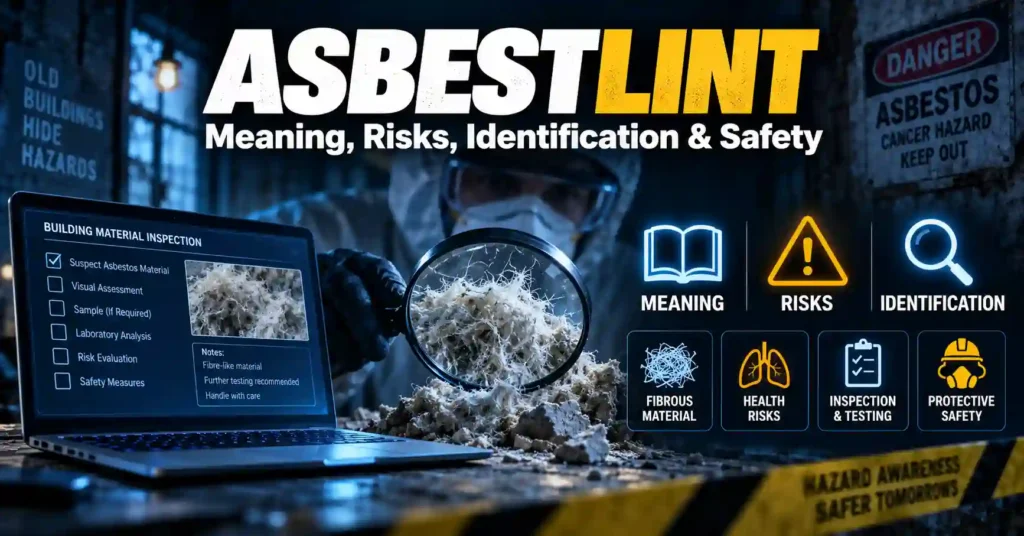
Asbestlint: Meaning, Asbestos Risks, and Safe Response
I think the first thing anyone searching for asbestlint needs is clarity, because the term is being used online in several different ways. Some recent English-language articles describe asbestlint as asbestos-containing tape, rope, cloth, insulation, or lint-like asbestos debris. Other sources treat it as a general term for fine material suspected of containing asbestos. Yet official Dutch and Flemish documents provide another important interpretation: “asbestlint” can refer to warning or barrier tape used to mark an asbestos-contaminated area. For example, a 2026 Flemish asbestos inspection guide lists “Afzetband / asbestlint” among inspection equipment, while Dutch fire-service guidance discusses using orange barrier tape because asbestos-marking tape was no longer available.
That ambiguity matters because asbestos itself is a serious health hazard, while a plastic warning tape labeled for asbestos obviously presents a completely different issue from an old woven material that actually contains asbestos fibers. In my analysis, the safest interpretation is therefore not to assume that every object called asbestlint contains asbestos. Instead, the word should be understood from its context, and any unidentified historical fibrous material should be assessed according to established asbestos guidance rather than its informal name. Current guidance from the World Health Organization, the U.S. Environmental Protection Agency, OSHA, CDC-affiliated ATSDR, and the UK’s Health and Safety Executive consistently emphasizes that exposure becomes a concern when asbestos-containing materials release fibers into the air.
Key Takeaways About Asbestlint
The most important fact about asbestlint is that it is not a single universally defined scientific or regulatory material name. Current online usage varies considerably, which means a search result alone cannot tell someone exactly what object or substance they have encountered.
Readers should keep these points in mind:
- Asbestlint is not a standard medical diagnosis or internationally recognized asbestos category.
- Some English-language sources use asbestlint for old asbestos tape, rope, cloth, or other flexible asbestos-containing materials.
- Other recent websites use the term for lint-like debris or dust suspected of containing asbestos fibers.
- Official Dutch and Flemish documents also use asbestlint to mean asbestos warning or barrier tape used to mark a restricted or contaminated area.
- A material cannot reliably be confirmed as asbestos simply by looking at it. The EPA recommends professional sampling when testing is appropriate.
- Undamaged asbestos-containing material that will not be disturbed may present much less exposure risk than damaged material releasing fibers.
- Cutting, drilling, sanding, scraping, breaking, or otherwise disturbing suspected asbestos can release fibers.
- All major forms of asbestos are carcinogenic to humans according to WHO.
- Anyone concerned about a meaningful asbestos exposure should discuss the situation with an appropriate medical professional rather than attempting to diagnose future disease from exposure circumstances alone.
From my perspective, the practical rule is simple: identify what the term means in the specific context first, and never disturb a suspicious old fibrous material merely to find out what it is.
What Is Asbestlint?
Asbestlint does not have one universally accepted English definition. That makes it different from recognized asbestos terminology such as asbestos-containing material, friable asbestos, chrysotile, amosite, crocidolite, airborne asbestos fibers, or asbestos cement.
Many recent English articles describe asbestlint as an informal label for flexible asbestos-containing products. These can include woven tapes, cords, ropes, cloth, packing materials, sealing strips, or similar textile-like products once valued for their resistance to heat. Other pages use the same word for fine dusty debris that people believe may contain asbestos.
However, there is an important language issue that makes broad definitions unreliable. Official material from Belgium’s Flemish Public Waste Agency lists “Afzetband / asbestlint” among equipment associated with asbestos inspection. In that context, it means barrier tape or marking tape used to control an area rather than asbestos-containing textile insulation. Dutch fire-service guidance similarly refers to marking a contaminated area with tape and notes the absence of dedicated asbestlint.
This evidence means the word cannot safely be translated into English as “asbestos rope” or “asbestos dust” in every context.
For example, a Dutch contractor’s equipment list could mention asbestlint even when referring to modern plastic tape marked with an asbestos warning. An English renovation forum, meanwhile, might use the same spelling to describe an old woven strip around a heating system.
I believe understanding this distinction is essential because the appropriate response depends on the object involved.
Why the Meaning of Asbestlint Is Confusing
Search results have helped spread several competing definitions.
One interpretation treats the word as a combination of asbestos and lint and therefore assumes it means lint-like asbestos dust.
Another connects it with old flexible asbestos products, including tape and rope.
A third interpretation comes from Dutch-language occupational practice, where the word can describe tape associated with marking asbestos work areas.
These interpretations overlap linguistically but not physically.
A strip of modern warning tape is a safety-control item.
A woven historical asbestos tape could itself contain hazardous mineral fibers.
Dust produced by disturbing an asbestos-containing material is something else again.
Using the same informal word for all three can cause unnecessary panic in one situation and dangerous complacency in another.
For that reason, professionals are more likely to use specific terminology. They identify the actual material, its condition, its location, whether asbestos is present, whether fibers may be released, and what regulations apply.
That is a much more useful approach than trying to determine risk from the word asbestlint alone.
The Main Meanings Associated With Asbestlint
The table below shows the different ways the keyword currently appears and why context matters.
| Use of “Asbestlint” | What It May Mean | Does the Term Alone Prove Asbestos Is Present? | Appropriate Interpretation |
|---|---|---|---|
| Dutch or Flemish safety context | Warning or barrier tape used around asbestos work | No | Check the document or product description |
| Historical building context | Woven tape, rope, cloth, cord, or sealing material suspected of containing asbestos | No | Treat unknown old material cautiously and obtain professional assessment if needed |
| Online home-safety article | Lint-like dust or fibrous debris suspected of containing asbestos | No | Do not assume dust composition from appearance |
| Renovation discussion | General shorthand for asbestos-related fibrous material | No | Identify the specific material before making conclusions |
| Professional asbestos assessment | Usually more specific terms are used instead | Not applicable | Rely on inspection, sampling, and laboratory analysis where appropriate |
The most important takeaway is that asbestlint is a contextual word rather than a laboratory identification. A name on a blog, forum, translated document, or product label cannot replace proper asbestos assessment.
What Asbestos Actually Is
Asbestos is the name given to a group of naturally occurring fibrous minerals. ATSDR describes asbestos minerals as forming long, thin, strong fibers that resist heat and fire and are difficult to break down. The legal definition used in the United States covers six asbestos minerals, including chrysotile, amosite, crocidolite, anthophyllite, tremolite, and actinolite.
These physical characteristics explain why asbestos became widely used in the twentieth century. Manufacturers incorporated it into building and industrial products where heat resistance, durability, fire resistance, insulation, or reinforcement were desirable.
Examples documented by U.S. health and safety authorities include insulation, roofing materials, floor tiles, cement products, wallboard, fireproofing materials, pipe insulation, brakes, clutches, and other construction products.
Asbestos could also be manufactured into textile-like forms. OSHA specifically notes historical worker exposure during the manufacture of asbestos products including textiles.
That history helps explain why an old woven strip, gasket, cloth, tape, or rope found near heat-producing equipment may raise legitimate questions about asbestos.
However, appearance alone still does not establish composition.
Where Asbestos-Containing Textile Materials May Have Been Used
Flexible asbestos products were useful in environments where conventional organic fibers could burn, degrade, or perform poorly under heat.
Historically, asbestos-containing products could appear around industrial heating systems, boilers, steam lines, furnaces, ducts, and other equipment. OSHA lists pipe insulation, boiler insulation, HVAC duct insulation, and electrical insulation among examples of asbestos applications found in older facilities.
Washington State’s Department of Health also notes that hot-water and steam pipes in older houses may be coated with asbestos material or covered with asbestos blankets or tape, while some oil and coal furnaces and door gaskets may contain asbestos insulation.
That information provides a better basis for assessing a suspicious woven product than the word asbestlint itself.
Consider a hypothetical scenario. A homeowner opens an unused basement service cupboard and discovers a pale woven strip wrapped around an old heating pipe. The material is frayed at one end. Searching photographs online might produce pages calling it asbestlint, asbestos tape, fiberglass tape, or heat-resistant cloth.
The correct conclusion is not that one matching photograph proves what the strip contains.
The safer conclusion is that the age, location, appearance, and condition justify avoiding disturbance until the material can be assessed if renovation or removal is planned.
Can You Identify Asbestlint by Looking at It?
Visual inspection cannot reliably confirm that a material contains asbestos.
The EPA states that it is not possible for a homeowner to determine whether a material contains asbestos simply by looking at it. When suspect material is damaged or will be disturbed during renovation, EPA recommends sampling by a properly trained and accredited asbestos professional and analysis by a qualified laboratory.
That recommendation addresses a common problem with online asbestos guides.
Photos can help someone recognize that a material deserves further investigation, but they cannot provide laboratory confirmation.
A white woven tape is not automatically asbestos.
A grey fibrous material is not automatically asbestos.
Old insulation is not automatically asbestos.
Likewise, material that looks harmless cannot automatically be declared asbestos-free.
Age, building records, product labels, historical documentation, professional inspection, and laboratory testing can all contribute to identification.
Why Damaged Asbestos Can Be Dangerous
The main health concern is inhalation of airborne asbestos fibers.
ATSDR explains that disturbing asbestos minerals or asbestos-containing materials can release fibers that are too small to see into the air. When inhaled, fibers can become lodged in the lungs and irritate lung tissue.
This is why the condition of a material matters so much.
A solid, intact asbestos-containing component that remains undisturbed presents a different exposure situation from deteriorating insulation that is being cut, drilled, scraped, sanded, or demolished.
The EPA states that asbestos-containing material in good condition and left undisturbed is unlikely to present a health risk. The concern increases when material becomes damaged or disturbed and fibers become airborne.
The UK’s Health and Safety Executive makes a similar distinction, particularly for older buildings. HSE explains that the risk of exposure is extremely low when asbestos is in good condition and remains undisturbed, while activities such as drilling, refurbishment, retrofitting, and demolition can create exposure risks by disturbing materials.
This is particularly relevant to something described as asbestlint if the word is being used for a flexible historical asbestos product. Fraying, breaking, pulling, scraping, or removing an old textile-like material could disturb fibers if the material actually contains asbestos.
What Health Problems Are Associated With Asbestos?
The health effects of asbestos are well established and far more important than debates over the informal term asbestlint.
WHO’s updated August 2026 fact sheet states:
“All forms of asbestos, including chrysotile, are carcinogenic to humans.”
World Health Organization
WHO identifies asbestos exposure as a cause of mesothelioma and cancers of the lung, larynx, and ovaries. It also identifies chronic respiratory disease, including asbestosis, as an established consequence of asbestos exposure.
ATSDR similarly explains that inhaled asbestos can cause lung cancer, mesothelioma, asbestosis, and pleural disease. It notes that mesothelioma signs may not appear until 30 to 40 years after exposure.
The long latency period is one reason asbestos can be psychologically difficult to understand. Someone exposed today will not necessarily experience an immediate warning symptom that confirms what happened.
Absence of immediate symptoms therefore does not prove that an exposure was harmless, while the fact that an exposure occurred also does not mean that a particular person will definitely develop an asbestos-related disease.
Risk depends on factors such as how much asbestos was in the air, frequency of exposure, duration, fiber characteristics, and other individual factors.
Is There a Safe Amount of Asbestos Exposure?
Health and occupational agencies encourage minimizing asbestos exposure rather than trying to identify a harmless amount for casual exposure.
OSHA states:
“There is no ‘safe’ level of asbestos exposure for any type of asbestos fiber.”
Occupational Safety and Health Administration
The EPA similarly says there is no known safe level of asbestos exposure in its current guidance on asbestos-contaminated vermiculite.
That statement should be interpreted responsibly.
It does not mean that every brief encounter produces disease or that all exposures carry identical risk. ATSDR explains that people exposed to asbestos do not always develop health problems and that risk depends on the amount, frequency, duration, and other circumstances of exposure.
The practical implication is that unnecessary exposure should be prevented rather than deliberately testing how much disturbance might be acceptable.
Why Friable Material Requires Particular Attention
The word “friable” has a specific meaning in asbestos safety.
OSHA explains that friable material can be crumbled with hand pressure and is therefore more likely to emit fibers. It gives sprayed fireproofing, insulation, and soundproofing as examples of materials that can release fibers readily when disturbed. By contrast, some nonfriable materials are less likely to release fibers unless they are cut, sawed, broken, or otherwise mechanically disturbed.
This concept helps make sense of suspected asbestlint.
A tightly bound, intact component is not the same exposure situation as an old fibrous product that is crumbling, fraying, deteriorating, or already producing debris.
A person does not need to determine friability themselves by squeezing or breaking an unknown material. Doing that could create the very disturbance they are trying to evaluate.
What to Do If You Find Material You Think Is Asbestlint
My recommendation is to prioritize non-disturbance and identification rather than immediate removal.
Step 1: Stop Disturbing the Material
If the material could plausibly contain asbestos, do not deliberately pull, cut, tear, scrape, sand, drill, brush, or break it to examine its structure.
EPA guidance specifically warns that asbestos-containing materials can release fibers when they are damaged, cut, torn, sanded, sawed, drilled, scraped, or improperly removed.
Step 2: Keep Unnecessary Activity Away From the Area
If suspicious material is already damaged, minimize unnecessary activity around it until appropriate advice is obtained.
The EPA recommends limiting activity in areas containing damaged material that may contain asbestos and avoiding actions that further damage it.
Step 3: Do Not Sweep or Vacuum Suspected Asbestos Debris
Ordinary household cleanup methods may disturb dust.
EPA homeowner guidance specifically advises against dusting, sweeping, or vacuuming debris that may contain asbestos.
Step 4: Record the Location Without Handling the Material
Make a note of where the suspected material is located and whether upcoming maintenance or renovation could disturb it.
Photographs taken without touching or approaching damaged material unnecessarily may help explain the situation to a qualified inspector, although photographs alone cannot confirm asbestos content.
Step 5: Determine Whether Professional Assessment Is Needed
If the material is damaged, renovation will disturb it, or its identity matters for planned work, contact a qualified asbestos professional according to the rules in your jurisdiction.
EPA recommends trained and accredited professionals for asbestos sampling because incorrect sampling itself can increase fiber release.
Step 6: Follow Local Asbestos Requirements
Rules governing asbestos surveys, removal, transport, worker protection, disposal, and licensing differ between countries and sometimes between states, provinces, or municipalities.
Do not assume that a removal procedure described for another country is legally appropriate where you live.
When Leaving Asbestos in Place May Be Safer
Finding asbestos does not automatically mean immediate removal is always the safest response.
This is one of the most important points in established guidance.
The EPA says:
“Usually the best thing is to leave asbestos-containing material alone if it is in good condition.”
U.S. Environmental Protection Agency
HSE provides similar guidance, stating that asbestos-containing materials in good condition and unlikely to be damaged can be left in place while the risk is properly managed.
Removal itself can create fiber release if performed incorrectly.
For homeowners, that means the discovery of a suspected old tape or gasket should not automatically trigger an improvised DIY removal project.
A professional assessment may determine that the material should remain undisturbed, be enclosed or repaired, or be removed through appropriate asbestos-control procedures.
Testing Suspected Asbestlint
Laboratory testing is what establishes whether a suspect building material actually contains asbestos.
The EPA states that the only way to be certain whether a material contains asbestos is to have it tested by a qualified laboratory. It recommends testing primarily when suspect material is damaged or when planned renovation will disturb it. Sampling should be carried out by a properly trained and accredited asbestos inspector.
I think this is a particularly important recommendation for people searching images of asbestlint online.
A photograph can generate a hypothesis.
A laboratory result can identify asbestos in a submitted sample.
Those are not the same level of evidence.
Professional assessment also provides context that a laboratory result alone may not capture, including the material’s condition, quantity, accessibility, location, and likelihood of disturbance.
Why DIY Sampling Can Create Additional Risk
Taking a sample requires disturbing the suspected material.
That is precisely why established guidance discourages inexperienced sampling.
The EPA explains that incorrectly performed sampling can be more hazardous than simply leaving the material alone.
Consider a hypothetical homeowner who discovers a brittle strip behind an old heating appliance. They decide to cut off a piece with scissors, place it in a sandwich bag, sweep the fragments, and mail the sample somewhere.
If the material contains asbestos, several opportunities for fiber release have now been created unnecessarily.
Professional procedures are designed around controlling those risks.
For this reason, I would not treat home asbestos sampling as an ordinary DIY material-identification project.
How Asbestlint Differs From Ordinary Lint
Another source of confusion comes from the word “lint.”
Ordinary household lint consists primarily of small fibers shed from fabrics, clothing, towels, carpets, paper, and similar materials.
Asbestos fibers are mineral fibers.
Finding fluff near a dryer, air vent, or fabric storage area therefore does not mean the material is asbestos.
Conversely, asbestos contamination cannot be excluded simply because debris resembles ordinary dust or lint.
The EPA notes that asbestos fibers cannot be identified reliably by normal visual inspection of suspect building materials.
That is why claims such as “asbestos lint is always grey,” “asbestlint feels like cotton,” or “you can identify asbestos fibers with a flashlight” should not be used as substitutes for professional evaluation.
Asbestlint Versus Asbestos Warning Tape
This distinction deserves special attention because it is supported by current official European documents.
In the Flemish asbestos inspection protocol published in March 2026, “Afzetband / asbestlint” appears on an equipment list beside items such as protective equipment, sampling supplies, waste bags, and tools. The wording indicates barrier or marking tape used during asbestos inspection activities.
Dutch emergency-response guidance provides even clearer context. It explains that a contaminated area should be marked off and refers to orange tape being used because dedicated asbestlint was no longer available.
In those contexts, asbestlint is a safety marking product.
It is not evidence that the tape itself contains asbestos.
This matters because an English speaker finding a roll labeled “asbestlint” in imported equipment might incorrectly conclude that the roll is made of asbestos.
Context should always come first.
Comparing Common Asbestlint Scenarios
The table below shows how I would interpret several realistic situations without making an unsupported asbestos diagnosis.
| Scenario | What Can Be Concluded | What Cannot Be Concluded | Sensible Next Step |
|---|---|---|---|
| New plastic tape marked for asbestos control | Likely a warning or barrier product | The label alone does not mean the tape contains asbestos | Read manufacturer information |
| Old woven strip around a heating pipe | Its location and age may justify asbestos suspicion | Appearance cannot confirm asbestos | Avoid disturbance and seek qualified assessment if needed |
| Fluffy debris below deteriorating pipe insulation | Damaged insulation deserves caution | Dust cannot be identified as asbestos visually | Restrict disturbance and obtain professional advice |
| Intact old gasket inside unused equipment | Historical use may make asbestos possible | It cannot be diagnosed from shape or color | Avoid disturbing it until work is planned |
| Ordinary dryer lint in a modern laundry room | Lint generation is normal | Appearance does not establish asbestos contamination | Investigate only if there is a separate reason to suspect asbestos |
| “Asbestlint” listed in a Dutch asbestos kit | Context suggests barrier tape | It should not automatically be interpreted as woven asbestos | Check the specific product or official documentation |
The overall pattern is consistent: identification depends on evidence, not on the keyword alone.
Common Mistakes About Asbestlint
Assuming Asbestlint Is One Official Material
There is no evidence that asbestlint is a universally standardized asbestos-material classification.
Current sources apply the term differently, and official European guidance demonstrates a barrier-tape meaning that many English articles overlook.
Assuming Anything Fibrous Is Asbestos
Fiberglass, mineral wool, natural fibers, synthetic textiles, cellulose products, insulation materials, and ordinary dust can all appear fibrous.
Visual similarity is not confirmation.
Pulling the Material Apart to Identify It
Physical disturbance is exactly what established asbestos guidance advises against when asbestos is suspected.
Do not turn identification into an exposure event.
Vacuuming Up Suspicious Dust
EPA guidance advises homeowners not to sweep, dust, or vacuum debris that may contain asbestos.
Assuming a Dust Mask Makes DIY Removal Safe
Asbestos work involves much more than simply putting on a mask.
Regulated professional work can involve training, exposure controls, containment, protective equipment, cleaning procedures, waste controls, and jurisdiction-specific requirements. OSHA’s asbestos standards, for example, establish regulated areas, work-practice controls, exposure monitoring, training requirements, and engineering controls for occupational situations.
Assuming Every Exposure Causes Disease
Asbestos exposure raises health risk, but exposure does not mean a disease diagnosis is inevitable.
ATSDR specifically notes that people who come into contact with asbestos do not always develop health problems and that risk depends on multiple exposure factors.
Assuming No Immediate Symptoms Means No Risk
Many asbestos-related diseases have long latency periods.
ATSDR notes that signs of mesothelioma may not appear until decades after exposure.
Renovation Work and Suspected Asbestlint
Renovation is one of the most important times to identify suspect materials because otherwise stable products may be disturbed.
Drilling a wall, removing pipe insulation, replacing an old boiler, opening service ducts, sanding flooring, or demolishing building components can change an intact material into an airborne-fiber problem if asbestos is present.
HSE specifically identifies drilling, refurbishment, retrofitting, demolition, and installation work as activities that can disturb asbestos-containing materials.
The EPA similarly recommends professional sampling when suspect materials will be disturbed during remodeling.
For a planned renovation, therefore, the right time to investigate suspicious old tape, cloth, insulation, or gaskets is before demolition begins.
Stopping halfway through a renovation after unknown fibrous debris has already spread is a much less desirable situation.
Asbestlint in Workplaces
Workers in construction, maintenance, demolition, shipyards, industrial plants, and older facilities can face different obligations from ordinary homeowners.
OSHA explains that occupational asbestos exposure is addressed through standards covering construction, general industry, and shipyard work. These standards include requirements related to training, exposure monitoring, regulated areas, work practices, and engineering controls.
HSE similarly emphasizes risk to tradespeople working on the fabric of older buildings, particularly when maintenance or refurbishment may disturb existing asbestos-containing materials.
If an employee discovers material suspected of containing asbestos, I would not recommend independently removing or sampling it outside established workplace procedures.
The responsible action is to follow the employer’s asbestos-management process, site controls, and applicable occupational regulations.
Asbestos Rules Differ by Country
Readers should be cautious with universal statements about who can remove asbestos, when surveys are mandatory, what disposal methods are allowed, or which products remain lawful.
Asbestos regulation varies internationally.
WHO reported in August 2026 that the use of asbestos has been prohibited in more than 50 member states, which also means prohibition is not universal worldwide.
In the United States, federal EPA and OSHA rules operate alongside state and local requirements. EPA notes, for example, that state and local rules may impose training or accreditation requirements beyond particular federal provisions affecting detached single-family homes.
In the United Kingdom, HSE provides specific duties and asbestos-management rules for workplaces and those carrying out work that may disturb asbestos.
European jurisdictions have their own inspection, inventory, removal, transport, and waste-management frameworks.
That is why a reader should confirm local requirements rather than copying an asbestos procedure from a website written for another country.
What to Do After a Possible Asbestos Exposure
A possible exposure should be approached calmly and factually.
If a person believes they may have inhaled asbestos fibers, the first priority is preventing further exposure.
ATSDR explains that asbestos fibers already deposited in the lungs cannot simply be removed and advises people concerned about asbestos exposure to speak with a doctor or other medical provider.
A clinician may consider the circumstances of the exposure, occupational history, duration, frequency, smoking history, existing lung conditions, and other relevant factors.
It is not possible to determine from an internet article whether a particular exposure will cause disease.
That is especially important for one-time accidental situations. Anxiety can lead people to assume that discovering an old suspect material means serious illness is inevitable. The available health guidance does not support that conclusion.
Risk exists on a spectrum, and meaningful individual assessment belongs with qualified healthcare professionals.
Why Smoking Matters After Asbestos Exposure
Smoking and asbestos have an especially important relationship with lung cancer risk.
WHO states that combined exposure to tobacco smoke and asbestos fibers substantially increases lung-cancer risk, with greater smoking associated with greater risk.
ATSDR also identifies cigarette smoking as an important factor affecting health risk after asbestos exposure.
This does not mean smoking causes every asbestos-related disease. Mesothelioma, for example, has a different relationship with asbestos exposure.
For someone with a meaningful asbestos-exposure history who smokes, discussing smoking cessation and overall respiratory health with a medical professional is a practical health step.
How Property Owners Can Manage Known Asbestos
Once asbestos has been properly identified, management should depend on condition, location, likelihood of disturbance, building use, and applicable regulation.
EPA guidance for building asbestos management explains that an accredited inspection can document asbestos-containing materials and assess their condition. In some cases, ongoing management may be appropriate. Significantly damaged material may require professional repair, encapsulation, enclosure, encasement, or removal.
This shows why “remove all asbestos immediately” is not always the correct universal advice.
Risk management is more nuanced.
An inaccessible, stable asbestos-containing component may remain managed in place.
A deteriorated product in a frequently accessed area may need more active intervention.
A renovation that will cut directly through asbestos-containing material changes the situation again.
Professional assessment considers those differences.
Why Accurate Language Matters With Asbestlint
Using the right words can prevent both panic and unsafe decisions.
If someone says “I found asbestlint,” I would want to know what they actually mean.
Did they find a roll of warning tape?
Did they find woven insulation?
Did they find rope packing?
Did they find dusty debris?
Did they see the word in an old document?
Did they encounter it in a Dutch-language safety guide?
Those questions can completely change the interpretation.
Calling unidentified dust “asbestlint” can falsely imply that asbestos has already been confirmed.
Calling historical woven insulation ordinary lint can minimize a legitimate concern.
Clear language keeps the focus on evidence.
When professionals are involved, terms such as suspected asbestos-containing material, asbestos textile, pipe insulation, gasket, rope packing, barrier tape, bulk sample, or airborne fiber are far more informative.
Practical Recommendations for Handling Asbestlint Questions
From the available evidence, I would use five principles whenever the term appears.
First, establish the context. Determine whether asbestlint refers to a warning product, historical building material, or informal description of debris.
Second, do not identify asbestos by appearance alone. Current EPA guidance explicitly says visual inspection is insufficient for certainty.
Third, avoid unnecessary disturbance. Material that is stable and undisturbed generally represents a lower exposure concern than material being damaged or mechanically worked.
Fourth, use qualified asbestos professionals when inspection, sampling, repair, or removal is required.
Finally, separate exposure risk from disease diagnosis. Exposure deserves appropriate prevention and, where relevant, medical discussion, but it does not allow anyone to predict an individual’s medical outcome from a photograph or brief description.
Conclusion
I believe the most important fact about asbestlint is that the word itself does not identify a specific hazardous material. Current sources use it in several ways, ranging from old asbestos-containing tape or fibrous products to suspected asbestos debris. Official Dutch and Flemish documents also show that asbestlint can simply mean warning or barrier tape used around an asbestos-controlled area. Context therefore matters before any conclusion is made.
When an unknown historical material could contain asbestos, the safest approach is not to touch, cut, sweep, sand, drill, or remove it merely to investigate. Asbestos risk arises primarily when fibers become airborne and are inhaled, while intact material that remains undisturbed may present far less exposure risk.
My practical recommendation is to treat the word as a starting point, not a diagnosis. Identify the actual object, consider its age and condition, avoid unnecessary disturbance, and use qualified asbestos professionals when testing or intervention is appropriate. Accurate terminology and cautious handling are much more useful than trying to identify asbestlint through photographs or assumptions.
Read More: Plangud: Meaning, Timber Uses & Planning Explained
Frequently Asked Questions
What Is Asbestlint?
Asbestlint is an ambiguous term rather than one universally recognized asbestos-material classification. Some English-language sources use it for asbestos-containing tape, rope, cloth, or fibrous debris, while official Dutch and Flemish safety documents use the word for barrier or warning tape associated with asbestos-controlled areas. The context in which the word appears therefore determines its likely meaning.
Is Asbestlint Dangerous?
Asbestlint is dangerous only if the term refers to material that actually contains asbestos and exposure to airborne fibers occurs. A modern plastic warning tape labeled for asbestos is not the same thing as historical asbestos-containing insulation. Confirmed asbestos can cause serious diseases when fibers are inhaled, including mesothelioma, lung cancer, and asbestosis.
How Can I Tell Whether Asbestlint Contains Asbestos?
You cannot reliably determine asbestos content from appearance alone. The EPA states that the only way to be certain whether a suspect material contains asbestos is through appropriate laboratory testing and recommends that sampling be performed by properly trained and accredited asbestos professionals. Photographs, texture, color, and age may raise suspicion but cannot confirm composition.
What Should I Do If I Find Suspected Asbestlint in My Home?
Avoid disturbing the material and determine whether professional assessment is appropriate. Do not cut, sand, scrape, drill, tear, sweep, or vacuum suspicious debris. EPA guidance advises leaving undamaged asbestos-containing material alone when it will not be disturbed and recommends qualified professionals when damaged material must be assessed, repaired, or removed. Local asbestos rules should also be checked.
Can Asbestos Be Safely Left in a Building?
Yes, in some situations properly managed asbestos-containing material can remain in place when it is in good condition and unlikely to be disturbed. EPA and HSE guidance both distinguish intact, undisturbed asbestos from damaged material that can release fibers. Whether management, repair, enclosure, encapsulation, or removal is appropriate depends on the specific situation and applicable regulations.
Does One Exposure to Asbestlint Mean I Will Get Sick?
No. An asbestos exposure does not mean that disease will definitely develop. ATSDR explains that risk depends on factors including the amount of asbestos in the air, how often exposure occurred, how long exposure lasted, and individual factors. Anyone concerned about a significant exposure should discuss the circumstances with an appropriate healthcare professional rather than assuming an outcome.
Is Asbestlint the Same as Ordinary Household Lint?
No. Ordinary lint normally consists of fibers shed from clothing, towels, carpets, paper, and other everyday materials. The term asbestlint is sometimes used online for asbestos-related fibrous material, but that informal usage does not turn normal lint into asbestos. Suspicious building materials cannot reliably be identified by visual appearance alone, so confirmation should rely on appropriate professional assessment and laboratory testing when necessary.
Does Asbestlint Always Mean Asbestos Tape?
No. This is one of the biggest misconceptions surrounding the keyword. Some recent English articles use asbestlint for asbestos tape or woven asbestos products, but Dutch and Flemish official documents use the same word to describe barrier tape associated with marking asbestos work or contamination zones. The surrounding language and purpose of the item should therefore be examined before interpreting the term.
Sources and References
- World Health Organization, “Asbestos,” updated August 11, 2026.
- Agency for Toxic Substances and Disease Registry, “Health Effects of Asbestos.”
- Agency for Toxic Substances and Disease Registry, “Preventing Asbestos Exposure.”
- U.S. Environmental Protection Agency, “Protect Your Family from Exposures to Asbestos.”
- U.S. Environmental Protection Agency, guidance on identifying asbestos before home remodeling.
- U.S. Environmental Protection Agency, guidance on health risks from asbestos in buildings.
- Occupational Safety and Health Administration, “Asbestos: Overview.”
- UK Health and Safety Executive, “Introduction to Asbestos Safety.”
- OVAM, Flemish asbestos inventory inspection guidance, version 2.2, March 11, 2026.
- Netherlands Institute for Public Safety, fire-service guidance on asbestos incidents and contaminated-area marking.
Disclaimer
This article provides general educational information about the term asbestlint and asbestos safety. It is not a material identification, asbestos survey, exposure assessment, medical diagnosis, legal opinion, or substitute for professional advice. Asbestos regulations, licensing requirements, testing rules, removal procedures, and disposal requirements vary by jurisdiction. Do not disturb suspected asbestos-containing material based solely on information from an online article. Where asbestos is suspected and assessment or work is necessary, consult appropriately qualified professionals and the relevant local health, environmental, workplace-safety, or regulatory authority.